
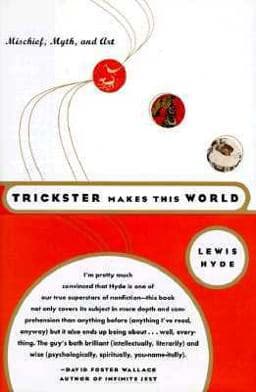
Trickster Makes This World
by Lewis Hyde
Format: Hardcover
ISBN13: 9780374958039
Hardcover|9780374958039
✨ Featured Offer
Brand New
$146.67
List Price: $0.01
🚚
See all 3 offers from $41.24 FREE standard delivery by: 30 Mar 2026
Overview
Trickster Makes This World
PART ONE
TRAP OF NATURE
1
SLIPPING THE TRAP OF APPETITE
The whitebait Opens its black eyes In the net of the Law.
--Basho
THE BAIT THIEF
The trickster myth derives creative intelligence from appetite. It begins with a being whose main concern is getting fed and it ends with the same being grown mentally swift, adept at creating and unmasking deceit, proficient at hiding his tracks and at seeing through the devices used by others to hide theirs. Trickster starts out hungry, but before long he is master of the kind of creative deception that, according to a long tradition, is a prerequisite of art. Aristotle wrote that Homer first "taught the rest of us the art of framing lies the right way." Homer makes lies seem so real that they enter the world and walk among us. Odysseus walks among us to this day, and he would seem to be Homer''s own self-portrait, for Odysseus, too, is a master of the art of lying, an art he got from his grandfather, Autolycus, who got it in turn from his father, Hermes. And Hermes, in an old story we shall soon consider, invented lying when he was a hungry child with a hankering for meat.
But I''m making a straight line out of a narrative that twists and turns,and I''m getting ahead of myself. We must begin at the beginning, with trickster learning how to keep his stomach full.
Trickster stories, even when they clearly have much more complicated cultural meanings, preserve a set of images from the days when what mattered above all else was hunting. At one point in the old Norse tales, the mischief-maker Loki has made the other gods so angry that he has to flee and go into hiding. In the mountains, he builds himself a house with doors on all sides so he can watch the four horizons. To amuse himself by day, he changes into a salmon, swimming the mountain streams, leaping the waterfalls. Sitting by the fire one morning, trying to imagine how the others might possibly capture him, he takes linen string and twists it into a mesh in the way that fishnets have been made ever since. Just at that moment, the others approach. Loki throws the net into the fire, changes into a salmon, and swims away. But the gods find the ashes of his net and from their pattern deduce the shape of the device they need to make. In this way, Loki is finally captured.
It makes a nice emblem of trickster''s ambiguous talents, Loki imagining that first fishnet and then getting caught in it. Moreover, the device in question is a central trickster invention. In Native American creation stories, when Coyote teaches humans how to catch salmon, he makes the first fish weir out of logs and branches. On the North Pacific coast, the trickster Raven made the first fishhook; he taught the spider how to make her web and human beings how to make nets. The history of trickery in Greece goes back to similar origins. "Trick" is dólos in Homeric Greek, and the oldest known use of the term refers to a quite specific trick: baiting a hook to catch a fish.
East and west, north and south, this is the oldest trick in the book. No trickster has ever been credited with inventing a potato peeler, a gas meter, a catechism, or a tuning fork, but trickster invents the fish trap.
Coyote was going along by a big river when he got very hungry. He built a trap of poplar poles and willow branches and set it in the water. "Salmon!" he called out. "Come into this trap." Soon a big salmon came along and swam into the chute of the trap and then flopped himself out on the bank where Coyote clubbed himto death. "I will find a nice place in the shade and broil this up," thought Coyote.
Trickster commonly relies on his prey to help him spring the traps he makes. In this fragment of a Nez Percé story from northeastern Idaho, Coyote''s salmon weir takes advantage of forces the salmon themselves provide. Salmon in a river are swimming upstream to spawn; sexual appetite or instinct gives them a particular trajectory and Coyote works with it. Even with a baited hook, the victim''s hunger is the moving part. The worm just sits there; the fish catches himself. Likewise, in a Crow story from the Western Plains, Coyote traps two buffalo by stampeding them into the sun so they cannot see where they are going, then leading them over a cliff. The fleetness of large herbivores is part of their natural defense against predators; Coyote (or the Native Americans who slaughtered buffalo in this way) takes advantage of that instinctual defense by directing the beasts into the sun and toward a cliff, so that fleetness itself backfires. In the invention of traps, trickster is a technician of appetite and a technician of instinct.
And yet, as the Loki story indicates, trickster can also get snared in his own devices. Trickster is at once culture hero and fool, clever predator and stupid prey. Hungry, trickster sometimes devises stratagems to catch his meal; hungry, he sometimes loses his wits altogether. An Apache story from Texas, in which Rabbit has played a series of tricks on Coyote, ends as follows:
Rabbit came to a field of watermelons. In the middle of the field there was a stick figure made of gum. Rabbit hit it with his foot and got stuck. He got his other foot stuck, then one hand and then his other hand and finally his head. This is how Coyote found him.
"What are you doing like this?" asked Coyote.
"The farmer who owns this melon patch was mad because I would not eat melons with him. He stuck me on here and said that in a while he would make me eat chicken with him. I told him I wouldn''t do it."
"You are foolish. I will take your place."
Coyote pulled Rabbit free and stuck himself up in the gumtrap. When the farmer who owned the melons came out and saw Coyote he shot him full of holes.
Coyote doesn''t just get stuck in gum traps, either; in other stories, a range of animals--usually sly cousins such as Fox or Rabbit or Spider--make a fool of him and steal his meat.
So trickster is cunning about traps but not so cunning as to avoid them himself. To my mind, then, the myth contains a story about the incremental creation of an intelligence about hunting. Coyote can imagine the fish trap precisely because he''s been a fish himself, as it were. Nothing counters cunning but more cunning. Coyote''s wits are sharp precisely because he has met other wits, just as the country bumpkin may eventually become a cosmopolitan if enough confidence men appear to school him.
Some recent ideas in evolutionary theory echo these assertions. In Evolution of the Brain and Intelligence, Harry Jerison presents a striking chart showing the relative intelligence of meat-eaters and the herbivores they prey on. Taking the ratio of brain to body size as a crude index, Jerison finds that if we compare herbivores and carnivores at any particular moment in history the predators are always slightly brainier than the prey. But the relationship is never stab≤ there is a slow step-by-step increase in intelligence on both sides. If we chart the brain-body ratio on a scale of 1 to 10, in the archaic age herbivores get a 2 and carnivores a 4; thirty million years later the herbivores are up to 4 but the carnivores have gone up to 6; another thirty million years and the herbivores are up to 6 but the carnivores are up to 8; finally, when the herbivores get up to 9, the carnivores are up to 10. The hunter is always slightly smarter, but the prey is always wising up. In evolutionary theory, the tension between predator and prey is one of the great engines that has driven the creation of intelligence itself, each side successively and ceaselessly responding to the other.
If this myth contains a story about incrementally increasing intelligence, where does it lead? What happens after the carnivore gets up to 10?
There is a great deal of folklore about coyotes in the American West. One story has it that in the old days sheep farmers tried to get rid ofwolves and coyotes by putting out animal carcasses laced with strychnine. The wolves, they say, were killed in great numbers, but the coyotes wised up and avoided these traps. Another story has it that when trappers set metal leg traps they will catch muskrat and mink and fox and skunk, but coyote only rarely. Coyotes develop their own relationship to the trap; as one naturalist has written, "it is difficult to escape the conclusion that coyotes ... have a sense of humor. How else to explain, for instance, the well-known propensity of experienced coyotes to dig up traps, turn them over, and urinate or defecate on them?"
With this image we move into a third relationship between tricksters and traps. When a coyote defecates on a trap he is neither predator nor prey but some third thing. A fragment of a native Tlingit story from Alaska will help us name that thing:
[Raven] came to a place where many people were encamped fishing ... . He entered a house and asked what they used for bait. They said, "Fat." Then he said, "Let me see you put enough on your hooks for bait," and he noticed carefully how they baited and handled their hooks. The next time they went out, he walked off behind a point and went underwater to get this bait. Now they got bites and pulled up quickly, but there was nothing on their hooks.
Raven eventually gets in trouble for this little trick (the fishermen steal his beak and he has to pull an elaborate return-ruse to get it ba
| ISBN-13 | 9780374958039 |
|---|---|
| ISBN-10 | 0374958033 |
| Weight | 1.54 Pounds |
| Dimensions | 4.38 x 0.01 x 21.08 In |
| List Price | $0.01 |
| Format | Hardcover |
|---|---|
| Language | English |
| Pages | 432 pages |
| Publisher | Farrar, Straus and Giroux |
| Published On | 1997-12-31 |
View All Offers
Sort by:
Price
Condition
Seller
Seller Comments
Price
Used, Very Good
Seller details
ZENO'S
San Francisco, CA, USA
New York. 1998. Farrar Straus Giroux. 1st Edition. Very Good in Dustjacket. 0374958033. 432 pages....
Free delivery by: 30 Mar 2026
Used, Like New
Seller details
Twice Sold Tales
Ashfield, MA, USA
2008 Cannondale (UK) hard cover-1st edition 1st printing-blue/grey dust jacket with fur tea set gr...
Free delivery by: 30 Mar 2026
✨ Brand New
Seller details
GridFreed
North Las Vegas, NV, USA
Size: 9x6x1; New. In shrink wrap. Looks like an interesting title!
Free delivery by: 30 Mar 2026
Bookstores.com relies on cookies to improve your experience.