
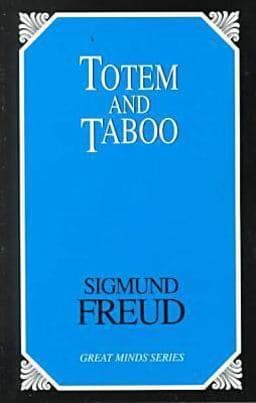
Totem and Taboo
Format: Paperback
ISBN13: 9781573927895
Paperback|9781573927895
✨ Featured Offer
Brand New
$19.98
List Price: $19.99
🚚
See all 5 offers from $11.86 FREE standard delivery by: 02 Apr 2026
Overview
In this controversial study Freud applies the theories and evidence of his psychoanalytic investigations to the study of aboriginal peoples and, by extension, to the earliest cultural stages of the human race before the rise of large-scale civilizations. Relying on the reports of ethnographers such as J. G. Frazer, E. B. Tylor, and others, Freud points out the striking parallels between the cultural practices of native tribal groups and the behavior patterns of neurotics. His ultimate aim is to shed light on the psychological factors involved in the development of culture in the same way as he analyzed the unconscious motivations of neurotic individuals.
Beginning with a discussion of the incest taboo, which is one of the main features of the totemic tribal structure, he compares the taboo to the infantile stage of individual psychological development, in which the male child experiences incestuous sexual feelings for his mother (and the girl for her father). He draws parallels between some of the elaborate taboo restrictions seen in these early cultures and the scrupulous rituals of compulsion neurotics, who in a similar fashion are wrestling with the ambivalent emotions aroused by the incest taboo. The implication is that many of the ceremonies and
rituals of culture develop as a psychological reaction to the incest taboo, which prohibits the acting out of an infantile impulse that would be socially destructive.
Freud contends that cultures evolve through three main stages: the animistic, the religious, and the scientific. The earliest stage of animism corresponds to the narcissistic phase of individual development, when the child overvalues the importance and influence of his inner psychic life on the outer world. In the religious stage of culture, humanity realizes that its own conceptions do not have full power to control outer reality and attributes this power to deities, who nonetheless can be manipulated through religious ceremony. This stage of culture corresponds to the individual growth phase of dependence on the parents. The scientific stage is tantamount to the mature phase of individual development, in which the individual recognizes his very limited power to control the universe and accepts the reality of his own death as well as all other natural realities.
Freud concludes by invoking his famous Oedipus complex as the key to the development of culture, just as it is the main conflict underlying all neurotic illness in his theory. The repressed psychological urge to kill the father as the rival for the mother's affections is the underlying motive for the symbols and ceremonies of religion with all its many sacrificial rituals of expiation and its notions of angry gods, original sin, and humankind's guilt and need for atonement.
Although Freud's theories and life are controversial today, this masterful synthesis and its undeniable influence on later scholars of religion, anthropology, and psychology make it an indispensable work.
Beginning with a discussion of the incest taboo, which is one of the main features of the totemic tribal structure, he compares the taboo to the infantile stage of individual psychological development, in which the male child experiences incestuous sexual feelings for his mother (and the girl for her father). He draws parallels between some of the elaborate taboo restrictions seen in these early cultures and the scrupulous rituals of compulsion neurotics, who in a similar fashion are wrestling with the ambivalent emotions aroused by the incest taboo. The implication is that many of the ceremonies and
rituals of culture develop as a psychological reaction to the incest taboo, which prohibits the acting out of an infantile impulse that would be socially destructive.
Freud contends that cultures evolve through three main stages: the animistic, the religious, and the scientific. The earliest stage of animism corresponds to the narcissistic phase of individual development, when the child overvalues the importance and influence of his inner psychic life on the outer world. In the religious stage of culture, humanity realizes that its own conceptions do not have full power to control outer reality and attributes this power to deities, who nonetheless can be manipulated through religious ceremony. This stage of culture corresponds to the individual growth phase of dependence on the parents. The scientific stage is tantamount to the mature phase of individual development, in which the individual recognizes his very limited power to control the universe and accepts the reality of his own death as well as all other natural realities.
Freud concludes by invoking his famous Oedipus complex as the key to the development of culture, just as it is the main conflict underlying all neurotic illness in his theory. The repressed psychological urge to kill the father as the rival for the mother's affections is the underlying motive for the symbols and ceremonies of religion with all its many sacrificial rituals of expiation and its notions of angry gods, original sin, and humankind's guilt and need for atonement.
Although Freud's theories and life are controversial today, this masterful synthesis and its undeniable influence on later scholars of religion, anthropology, and psychology make it an indispensable work.
| ISBN-13 | 9781573927895 |
|---|---|
| ISBN-10 | 1573927899 |
| Weight | 0.77 Pounds |
| Dimensions | 5.45 x 0.65 x 8.38 In |
| List Price | $19.99 |
| Edition | 1st Edition |
| Format | Paperback |
|---|---|
| Pages | 281 pages |
| Publisher | Prometheus |
| Published On | 2000-03-01 |
View All Offers
Sort by:
Price
Condition
Seller
Seller Comments
Price
Used, Good
Seller details
BooksRun
Philadelphia, PA, USA
It's a preowned item in good condition and includes all the pages. It may have some general signs ...
Free delivery by: 02 Apr 2026
Used, Very Good
Seller details
HPB Inc.
Dallas, TX, USA
Connecting readers with great books since 1972! Used books may not include companion materials, and ...
Free delivery by: 02 Apr 2026
✨ Brand New
Seller details
Alibris
Sparks, NV, USA
Print on demand Trade paperback (US). Glued binding. 281 p. Great Minds.
Free delivery by: 02 Apr 2026
Brand New
Seller details
FirstClassBooks
Little Rock, AR, USA
Free delivery by: 02 Apr 2026
Brand New
Seller details
eCampus.com
Lexington, KY, USA
Free delivery by: 02 Apr 2026