
✨ Featured Offer
Used, Very Good
$12.81
List Price: $37.00
🚚
See all 5 offers from $11.79 FREE standard delivery by: 30 Mar 2026
Overview
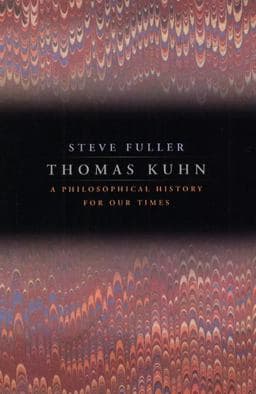
Thomas Kuhn's The Structure of Scientific Revolutions is one of the best known and most influential books of the twentieth century. Whether they adore or revile him, critics and fans alike have tended to agree on one thing: Kuhn's ideas were revolutionary. But were they?
Steve Fuller argues that Kuhn actually held a profoundly conservative view of science and how one ought to study its history. Early on, Kuhn came under the influence of Harvard President James Bryant Conant (to whom Structure is dedicated), who had developed an educational program intended to help deflect Cold War unease over science's uncertain future by focusing on its illustrious past. Fuller argues that this rhetoric made its way into Structure, which Fuller sees as preserving and reinforcing the old view that science really is just a steady accumulation of truths about the world (once "paradigm shifts" are resolved).
Fuller suggests that Kuhn, deliberately or not, shared the tendency in Western culture to conceal possible negative effects of new knowledge from the general public. Because it insists on a difference between a history of science for scientists and one suited to historians, Fuller charges that Structure created the awkward divide that has led directly to the "Science Wars" and has stifled much innovative research. In conclusion, Fuller offers a way forward that rejects Kuhn's fixation on paradigms in favor of a conception of science as a social movement designed to empower society's traditionally disenfranchised elements.
Certain to be controversial, Thomas Kuhn must be read by anyone who has adopted, challenged, or otherwise engaged with The Structure of Scientific Revolutions.
"Structure will never look quite the same again after Fuller. In that sense, he has achieved one of the main aims of his ambitious and impressively executed project."--Jon Turney, Times Higher Education Supplement
"Philosophies like Kuhn's narrow the possible futures of inquiry by politically methodizing and taming them. More republican philosophies will leave the future open. Mr. Fuller has amply succeeded in his program of distinguishing the one from the other."--William R. Everdell, Washington Times
Steve Fuller argues that Kuhn actually held a profoundly conservative view of science and how one ought to study its history. Early on, Kuhn came under the influence of Harvard President James Bryant Conant (to whom Structure is dedicated), who had developed an educational program intended to help deflect Cold War unease over science's uncertain future by focusing on its illustrious past. Fuller argues that this rhetoric made its way into Structure, which Fuller sees as preserving and reinforcing the old view that science really is just a steady accumulation of truths about the world (once "paradigm shifts" are resolved).
Fuller suggests that Kuhn, deliberately or not, shared the tendency in Western culture to conceal possible negative effects of new knowledge from the general public. Because it insists on a difference between a history of science for scientists and one suited to historians, Fuller charges that Structure created the awkward divide that has led directly to the "Science Wars" and has stifled much innovative research. In conclusion, Fuller offers a way forward that rejects Kuhn's fixation on paradigms in favor of a conception of science as a social movement designed to empower society's traditionally disenfranchised elements.
Certain to be controversial, Thomas Kuhn must be read by anyone who has adopted, challenged, or otherwise engaged with The Structure of Scientific Revolutions.
"Structure will never look quite the same again after Fuller. In that sense, he has achieved one of the main aims of his ambitious and impressively executed project."--Jon Turney, Times Higher Education Supplement
"Philosophies like Kuhn's narrow the possible futures of inquiry by politically methodizing and taming them. More republican philosophies will leave the future open. Mr. Fuller has amply succeeded in his program of distinguishing the one from the other."--William R. Everdell, Washington Times
| ISBN-13 | 9780226268965 |
|---|---|
| ISBN-10 | 0226268969 |
| Weight | 1.42 Pounds |
| Dimensions | 6.00 x 1.00 x 9.00 In |
| List Price | $37.00 |
| Edition | 2nd Edition |
| Format | Paperback |
|---|---|
| Language | English |
| Pages | 490 pages |
| Publisher | University of Chicago Press |
| Published On | 2001-12-01 |
View All Offers
Sort by:
Price
Condition
Seller
Seller Comments
Price
Used, Good
Seller details
HPB-Red
Dallas, TX, USA
Connecting readers with great books since 1972! Used textbooks may not include companion materials s...
Free delivery by: 30 Mar 2026
Used, Good
Seller details
Greenworld Books
Arlington, TX, USA
Good condition. It may show normal signs of use such as light writing highlighting or library markin...
Free delivery by: 30 Mar 2026
✨ Used, Very Good
Seller details
Greenworld Books
Arlington, TX, USA
Fast-Very Good condition book with a firm cover and clean pages. Shows normal use and some light wea...
Free delivery by: 30 Mar 2026
Used, Very Good
Seller details
Common Crow Books
Pittsburgh, PA, USA
Paperback, 472pp.
Free delivery by: 30 Mar 2026
Used, Very Good
Seller details
Powell's Books Chicago
Chicago, IL, USA
Pap. Minor shelf wear. Else clean copy.
Free delivery by: 30 Mar 2026