
✨ Featured Offer
Used, Very Good
$20.57
List Price: $24.95
🚚
See all 4 offers from $20.41 FREE standard delivery by: 30 Mar 2026
Overview
Where am I? What can I do here? Where can I go from here? How do I get out of here?
Consciously or not, we ask such questions every day as we navigate the places and spaces of our lives. Whether we find ourselves in a museum, hospital, airport, mall, or street in an unfamiliar city, we depend on systems of visual, audible, and tactile cues not only to lead the way, but also to keep us safe. They are the fundamental questions of wayfindinga process that encompasses both the experience of choosing a path within a built environment and the set of design elements that aid in such a decision. A decade ago, the professional practice of wayfinding design simply involved devising sign systems. Today, the field is much broader and continues to expand to address technological developmentskinetic media, GPS systems, web connectivity, smart materialsas well as cultural changes in areas such as branding and environmental awareness. Similarly, a cross-disciplinary familiarity with graphic, architectural, landscape, interior, industrial, and information design has become an essential requirement of twenty-first-century wayfinding design.
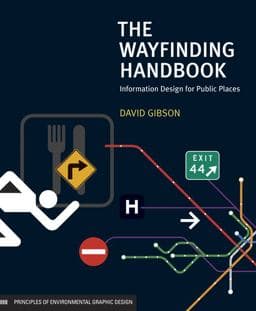
The Wayfinding Handbook is an exciting new volume in our acclaimed Design Briefs series. Professional wayfinding designer David Gibson draws on more than thirty years of experience collaborating with architects, planners, developers, managers, and civic leaders to offer an insider's view of this rapidly evolving discipline. Using real-life examples, Gibson illustrates the way type, color, mapmaking, dimensional forms, material selection, and new media are used to create effective wayfinding systems.
The Wayfinding Handbook is a complete guide to the discipline, from planning and design to practical considerations, such as setting up teams and managing projects. "Other Voices" sidebars, presentedthroughout the book, reveal the opinions of experts who plan, manage, and shape wayfinding projects. A comprehensive bibliography and gallery of resources round out what is likely to become the go-to resource for students, professionals, or anyone charged with designing people-friendly, universally accessible environments.
Consciously or not, we ask such questions every day as we navigate the places and spaces of our lives. Whether we find ourselves in a museum, hospital, airport, mall, or street in an unfamiliar city, we depend on systems of visual, audible, and tactile cues not only to lead the way, but also to keep us safe. They are the fundamental questions of wayfindinga process that encompasses both the experience of choosing a path within a built environment and the set of design elements that aid in such a decision. A decade ago, the professional practice of wayfinding design simply involved devising sign systems. Today, the field is much broader and continues to expand to address technological developmentskinetic media, GPS systems, web connectivity, smart materialsas well as cultural changes in areas such as branding and environmental awareness. Similarly, a cross-disciplinary familiarity with graphic, architectural, landscape, interior, industrial, and information design has become an essential requirement of twenty-first-century wayfinding design.
The Wayfinding Handbook is an exciting new volume in our acclaimed Design Briefs series. Professional wayfinding designer David Gibson draws on more than thirty years of experience collaborating with architects, planners, developers, managers, and civic leaders to offer an insider's view of this rapidly evolving discipline. Using real-life examples, Gibson illustrates the way type, color, mapmaking, dimensional forms, material selection, and new media are used to create effective wayfinding systems.
The Wayfinding Handbook is a complete guide to the discipline, from planning and design to practical considerations, such as setting up teams and managing projects. "Other Voices" sidebars, presentedthroughout the book, reveal the opinions of experts who plan, manage, and shape wayfinding projects. A comprehensive bibliography and gallery of resources round out what is likely to become the go-to resource for students, professionals, or anyone charged with designing people-friendly, universally accessible environments.
| ISBN-13 | 9781568987699 |
|---|---|
| ISBN-10 | 1568987692 |
| Weight | 0.88 Pounds |
| Dimensions | 7.00 x 0.50 x 8.50 In |
| List Price | $24.95 |
| Edition | 1st Edition |
| Format | Paperback |
|---|---|
| Language | English |
| Pages | 152 pages |
| Publisher | Princeton Architectural Press |
| Published On | 2009-02-04 |
View All Offers
Sort by:
Price
Condition
Seller
Seller Comments
Price
Used, Good
Seller details
Evergreen Goodwill
Seattle, WA, USA
Free delivery by: 30 Mar 2026
✨ Used, Very Good
Seller details
The Maryland Book Bank
baltimore, MD, USA
Used-Very Good.
Free delivery by: 30 Mar 2026
Used, Very Good
Seller details
HPB-Movies
Dallas, TX, USA
Connecting readers with great books since 1972! Used books may not include companion materials, and ...
Free delivery by: 30 Mar 2026
Used, Good
Seller details
Bonita
Santa Clarita, CA, USA
Access codes and supplements are not guaranteed with used items. May be an ex-library book.
Free delivery by: 30 Mar 2026