
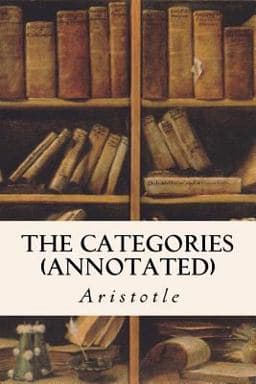
The Categories (annotated)
Format: Paperback
ISBN13: 9781517788377
Paperback|9781517788377
✨ Featured Offer
Overview
The Categories is a text from Aristotle's Organon that enumerates all the possible kinds of things that can be the subject or the predicate of a proposition. They are "perhaps the single most heavily discussed of all Aristotelian notions". The work is brief enough to be divided, not into books as is usual with Aristotle's works, but into fifteen chapters.The Categories places every object of human apprehension under one of ten categories (known to medieval writers as the Latin term praedicamenta). Aristotle intended them to enumerate everything that can be expressed without composition or structure, thus anything that can be either the subject or the predicate of a proposition.The antepraedicamenta[edit]The text begins with an explication of what is meant by "synonymous," or univocal words, what is meant by "homonymous," or equivocal words, and what is meant by "paronymous," or denominative (sometimes translated "derivative") words.It then divides forms of speech as being:Either simple, without composition or structure, such as "man," "horse," "fights," etc.Or having composition and structure, such as "a man fights," "the horse runs," etc.Only composite forms of speech can be true or false.Then, Aristotle discusses semantical relations to develop four types of a subject using the foundational relationship between being said "of" a subject and being present "in" [present "in" does not define present as pieces to a whole, but rather existence contingent upon a subject] a subject. The four characterizations of a subject are understood whether a subject is said "of" (Universals), is not said "of" (Particulars), is present "in" (Accidental), is not present "in" (non-accidental).[3] In combination, a non-accidental, universals subject is referred to as Essential; where as a non-accidental, particulars subject is simply non-accidental.[4]The four characterizations create four classification permutations:1. Accidental Universals - said "of" and present "in" - for example, while knowledge is present "in" the human mind, one can have the knowledge (said "of") of grammar.2. Essential Universals - said "of" and not present "in" - refers to a general subject, but cannot be present "in" a unit of the subject; like man, horse, animal.3. Accidental Particulars - not said "of" and present "in" - for example, a certain point of grammatical knowledge is present "in" a subject, but it cannot designate a subject.4. Non-Accidental Particulars - not said "of" and not present "in" (defines Primary Substances - covered under Substances) - Aristotle views that which is individual and has the character of a unit is neither said "of" or present "in" of a subject.
| ISBN-13 | 9781517788377 |
|---|---|
| ISBN-10 | 1517788374 |
| Weight | 0.24 Pounds |
| Dimensions | 6.00 x 0.15 x 9.00 In |
| List Price | $5.75 |
| Edition | 1st Edition |
| Format | Paperback |
|---|---|
| Language | English |
| Pages | 74 pages |
| Publisher | CreateSpace Independent Publishing Platform |
| Published On | 2015-10-13 |
View All Offers
Sort by:
Price
Condition
Seller
Seller Comments
Price
Used, Like New
Seller details
GreatBookPrices-
Columbia, MD, USA
100% Money Back Guarantee. Brand New, Perfect Condition. We offer expedited shipping to all US locat...
Free delivery by: 29 Mar 2026
Used, Good
Seller details
Bonita
Santa Clarita, CA, USA
Access codes and supplements are not guaranteed with used items. May be an ex-library book.
Free delivery by: 29 Mar 2026
✨ Brand New
Seller details
GreatBookPrices-
Columbia, MD, USA
100% Money Back Guarantee. Brand New, Perfect Condition. We offer expedited shipping to all US locat...
Free delivery by: 29 Mar 2026