
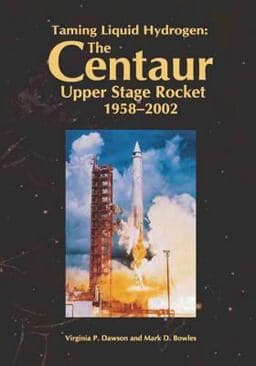
Taming Liquid Hydrogen: the Centaur Upper Stage Rocket, 1958-2002
Format: Paperback
ISBN13: 9781493586301
Paperback|9781493586301
✨ Featured Offer
Brand New
$21.39
List Price: $19.99
🚚
See all 3 offers from $21.39 FREE standard delivery by: 31 Mar 2026
Overview
During its maiden voyage in May 1962, a Centaur upper stage rocket, mated to an Atlas booster, exploded 54 seconds after launch, engulfing the rocket in a huge fireball. Investigation revealed that Centaur's light, stainless-steel tank had split open, spilling its liquid-hydrogen fuel down its sides, where the flame of the rocket exhaust immediately ignited it. Coming less than a year after President Kennedy had made landing human beings on the Moon a national priority, the loss of Centaur was regarded as a serious setback for the National Aeronautics and Space Administration (NASA). During the failure investigation, Homer Newell, Director of Space Sciences, ruefully declared: "Taming liquid hydrogen to the point where expensive operational space missions can be committed to it has turned out to be more difficult than anyone supposed at the outset." .After this failure, Centaur critics, led by Wernher von Braun, mounted a campaign to cancel the program. In addition to the unknowns associated with liquid hydrogen, he objected to the unusual design of Centaur. Like the Atlas rocket, Centaur depended on pressure to keep its paper thin, stainless-steel shell from collapsing. It was literally inflated with its propellants like a football or balloon and needed no internal structure to give it added strength and stability. The so-called "pressure-stabilized structure" of Centaur, coupled with the light weight of its high-energy cryogenic propellants, made Centaur lighter and more powerful than upper stages that used conventional fuel. But, the critics argued, it would never become the reliable rocket that the United States needed. Others, especially military proponents of Centaur, believed that accepting the challenge of developing liquid-hydrogen technology was an important risk to take. Despite criticism and early technical failures, the taming of liquid hydrogen proved to be one of NASA's most significant technical accomplishments. Centaur not only succeeded in demonstrating the feasibility of liquid hydrogen as a rocket fuel, but it also went on to a brilliant career as an upper stage for a series of spectacular planetary missions in the 1970s. Ironically, this success did little to ensure the future of the Centaur rocket. Once the Shuttle became operational in the early 1980s, all expendable launch vehicles like Centaur were slated for termination. Centaur advocates fought to keep the program alive.
| ISBN-13 | 9781493586301 |
|---|---|
| ISBN-10 | 1493586300 |
| Weight | 1.18 Pounds |
| Dimensions | 7.01 x 0.64 x 10.00 In |
| List Price | $19.99 |
| Format | Paperback |
|---|---|
| Language | English |
| Pages | 306 pages |
| Publisher | CreateSpace Independent Publishing Platform |
| Published On | 2013-10-25 |
View All Offers
Sort by:
Price
Condition
Seller
Seller Comments
Price
✨ Brand New
Seller details
Alibris
Sparks, NV, USA
Print on demand Trade paperback (US). Glued binding. 306 p.
Free delivery by: 31 Mar 2026
Brand New
Seller details
GreatBookPrices-
Columbia, MD, USA
100% Money Back Guarantee. Brand New, Perfect Condition. We offer expedited shipping to all US locat...
Free delivery by: 31 Mar 2026
Used, Good
Seller details
Bonita
Santa Clarita, CA, USA
Access codes and supplements are not guaranteed with used items. May be an ex-library book.
Free delivery by: 31 Mar 2026