
✨ Featured Offer
Brand New
$16.38
List Price: $16.00
🚚
See all 5 offers from $14.18 FREE standard delivery by: 31 Mar 2026
Overview
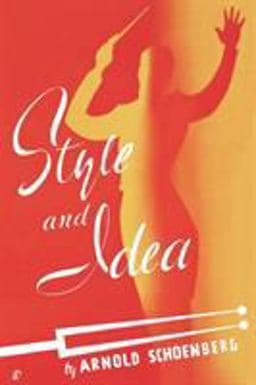
This book is full of essays which Arnold Schoenberg wrote on style and idea. He talks about the relationship to the text, new and outmoded music, composition in twelve tones, entertaining through composing, the relationship of heart and mind in music, evaluation of music, and other essays. Arnold Schoenberg (13 September 1874 - 13 July 1951) was an Austrian and later American composer, associated with the expressionist movement in German poetry and art, and leader of the Second Viennese School. He used the spelling Sch nberg until after his move to the United States in 1934 (Steinberg 1995, 463), "in deference to American practice" (Foss 1951, 401), though one writer claims he made the change a year earlier (Ross 2007, 45). Schoenberg was known early in his career for successfully extending the traditionally opposed German Romantic traditions of both Brahms and Wagner, and later and more notably for his pioneering innovations in atonality. During the rise of the Nazi party in Austria, his music was labeled, alongside swing and jazz, as degenerate art. In the 1920s, he developed the twelve-tone technique, a widely influential compositional method of manipulating an ordered series of all twelve notes in the chromatic scale. He also coined the term developing variation, and was the first modern composer to embrace ways of developing motifs without resorting to the dominance of a centralized melodic idea. Schoenberg's approach, both in terms of harmony and development, is among the major landmarks of 20th century musical thought; at least three generations of composers in the European and American traditions have consciously extended his thinking and, in some cases, passionately reacted against it. Schoenberg was also a painter, an important music theorist, and an influential teacher of composition; his students included Alban Berg, Anton Webern, Hanns Eisler, and later John Cage, Lou Harrison, Earl Kim, Wayne Barlow, and many other prominent musicians. Many of Schoenberg's practices, including the formalization of compositional method, and his habit of openly inviting audiences to think analytically, are echoed in avant-garde musical thought throughout the 20th century. His often polemical views of music history and aesthetics were crucial to many of the 20th century's significant musicologists and critics, including Theodor Adorno, Charles Rosen, and Carl Dahlhaus. Schoenberg's archival legacy is collected at the Arnold Sch nberg Center in Vienna.
| ISBN-13 | 9780806530956 |
|---|---|
| ISBN-10 | 0806530952 |
| Weight | 0.77 Pounds |
| Dimensions | 6.00 x 0.54 x 9.00 In |
| List Price | $16.00 |
| Format | - |
|---|---|
| Language | English |
| Pages | 236 pages |
| Publisher | Philosophical Library |
| Published On | 1950-01-01 |
View All Offers
Sort by:
Price
Condition
Seller
Seller Comments
Price
Used, Good
Seller details
Zoom Books East
Glendale Heights, IL, USA
Book is in good condition and may include underlining highlighting and minimal wear. The book can al...
Free delivery by: 31 Mar 2026
✨ Brand New
Seller details
Alibris
Sparks, NV, USA
Print on demand Trade paperback (US). Glued binding. 236 p.
Free delivery by: 31 Mar 2026
Brand New
Seller details
GreatBookPrices-
Columbia, MD, USA
100% Money Back Guarantee. Brand New, Perfect Condition. We offer expedited shipping to all US locat...
Free delivery by: 31 Mar 2026
Brand New
Seller details
Paperbackshop
Bensenville, IL, USA
New Book. Shipped from UK in 4 to 14 days. Established seller since 2000. Please note we cannot of...
Free delivery by: 31 Mar 2026
Used, Good
Seller details
Bonita
Santa Clarita, CA, USA
Access codes and supplements are not guaranteed with used items. May be an ex-library book.
Free delivery by: 31 Mar 2026