
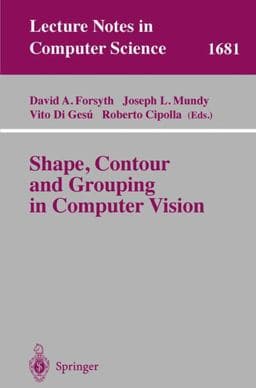
Shape, Contour and Grouping in Computer Vision
Format: Paperback
ISBN13: 9783540667223
Paperback|9783540667223
✨ Featured Offer
Brand New
$58.73
List Price: $54.99
🚚
See all 3 offers from $33.22 FREE standard delivery by: 04 Apr 2026
Overview
Computer vision has been successful in several important applications recently. Vision techniques can now be used to build very good models of buildings from pictures quickly and easily, to overlay operation planning data on a neuros- geon's view of a patient, and to recognise some of the gestures a user makes to a computer. Object recognition remains a very di cult problem, however. The key questions to understand in recognition seem to be: (1) how objects should be represented and (2) how to manage the line of reasoning that stretches from image data to object identity. An important part of the process of recognition {{ perhaps, almost all of it {{ involves assembling bits of image information into helpful groups. There is a wide variety of possible criteria by which these groups could be established {{ a set of edge points that has a symmetry could be one useful group; others might be a collection of pixels shaded in a particular way, or a set of pixels with coherent colour or texture. Discussing this process of grouping requires a detailed understanding of the relationship between what is seen in the image and what is actually out there in the world.
| ISBN-13 | 9783540667223 |
|---|---|
| ISBN-10 | 3540667229 |
| Weight | 1.13 Pounds |
| Dimensions | 6.14 x 0.82 x 9.21 In |
| List Price | $54.99 |
| Edition | 1st Edition |
| Format | Paperback |
|---|---|
| Language | English |
| Pages | viii, 350 pages |
| Publisher | Springer |
| Published On | 1999-11-03 |
View All Offers
Sort by:
Price
Condition
Seller
Seller Comments
Price
Used, Very Good
Seller details
GuthrieBooks
Spring Branch, TX, USA
Size: 6x0x9; Ex-library paperback in very nice condition with the usual markings and attachments.
Free delivery by: 04 Apr 2026
✨ Brand New
Seller details
Alibris
Sparks, NV, USA
Trade paperback (US). Glued binding. 350 p. Lecture Notes in Computer Science, 1681.
Free delivery by: 04 Apr 2026
Used, Good
Seller details
Bonita
Santa Clarita, CA, USA
Access codes and supplements are not guaranteed with used items. May be an ex-library book.
Free delivery by: 04 Apr 2026