
✨ Featured Offer
Brand New
$47.30
List Price: $32.50
🚚
See all 5 offers from $20.74 FREE standard delivery by: 03 Apr 2026
Overview
Winner: Thomas M. Cooley Book Prize
Thomas M. Cooley Book Prize Choice Outstanding Academic Title
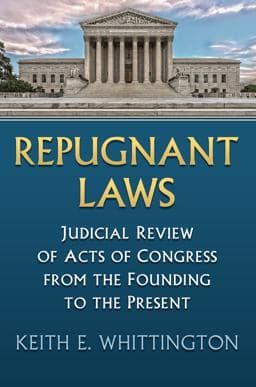
When the Supreme Court strikes down favored legislation, politicians cry judicial activism. When the law is one politicians oppose, the court is heroically righting a wrong. In our polarized moment of partisan fervor, the Supreme Court's routine work of judicial review is increasingly viewed through a political lens, decried by one side or the other as judicial overreach, or "legislating from the bench." But is this really the case? Keith E. Whittington asks in Repugnant Laws, a first-of-its-kind history of judicial review.
A thorough examination of the record of judicial review requires first a comprehensive inventory of relevant cases. To this end, Whittington revises the extant catalog of cases in which the court has struck down a federal statute and adds to this, for the first time, a complete catalog of cases upholding laws of Congress against constitutional challenges. With reference to this inventory, Whittington is then able to offer a reassessment of the prevalence of judicial review, an account of how the power of judicial review has evolved over time, and a persuasive challenge to the idea of an antidemocratic, heroic court. In this analysis, it becomes apparent that that the court is political and often partisan, operating as a political ally to dominant political coalitions; vulnerable and largely unable to sustain consistent opposition to the policy priorities of empowered political majorities; and quasi-independent, actively exercising the power of judicial review to pursue the justices' own priorities within bounds of what is politically tolerable.
The court, Repugnant Laws suggests, is a political institution operating in a political environment to advance controversial principles, often with the aid of political leaders who sometimes encourage and generally tolerate the judicial nullification of federal laws because it serves their own interests to do so. In the midst of heated battles over partisan and activist Supreme Court justices, Keith Whittington's work reminds us that, for better or for worse, the court reflects the politics of its time.
Thomas M. Cooley Book Prize Choice Outstanding Academic Title
When the Supreme Court strikes down favored legislation, politicians cry judicial activism. When the law is one politicians oppose, the court is heroically righting a wrong. In our polarized moment of partisan fervor, the Supreme Court's routine work of judicial review is increasingly viewed through a political lens, decried by one side or the other as judicial overreach, or "legislating from the bench." But is this really the case? Keith E. Whittington asks in Repugnant Laws, a first-of-its-kind history of judicial review.
A thorough examination of the record of judicial review requires first a comprehensive inventory of relevant cases. To this end, Whittington revises the extant catalog of cases in which the court has struck down a federal statute and adds to this, for the first time, a complete catalog of cases upholding laws of Congress against constitutional challenges. With reference to this inventory, Whittington is then able to offer a reassessment of the prevalence of judicial review, an account of how the power of judicial review has evolved over time, and a persuasive challenge to the idea of an antidemocratic, heroic court. In this analysis, it becomes apparent that that the court is political and often partisan, operating as a political ally to dominant political coalitions; vulnerable and largely unable to sustain consistent opposition to the policy priorities of empowered political majorities; and quasi-independent, actively exercising the power of judicial review to pursue the justices' own priorities within bounds of what is politically tolerable.
The court, Repugnant Laws suggests, is a political institution operating in a political environment to advance controversial principles, often with the aid of political leaders who sometimes encourage and generally tolerate the judicial nullification of federal laws because it serves their own interests to do so. In the midst of heated battles over partisan and activist Supreme Court justices, Keith Whittington's work reminds us that, for better or for worse, the court reflects the politics of its time.
| ISBN-13 | 9780700630363 |
|---|---|
| ISBN-10 | 0700630368 |
| Weight | 1.31 Pounds |
| Dimensions | 5.75 x 0.75 x 8.75 In |
| List Price | $32.50 |
| Format | Paperback |
|---|---|
| Language | English |
| Pages | 432 pages |
| Publisher | University Press of Kansas |
| Published On | 2020-05-18 |
View All Offers
Sort by:
Price
Condition
Seller
Seller Comments
Price
Used, Very Good
Seller details
Midtown Scholar Bookstore
Harrisburg, PA, USA
Very Good-Crisp, clean, unread book with some shelfwear/edgewear, may have a remainder mark-NICE PAP...
Free delivery by: 03 Apr 2026
Used, Like New
Seller details
GreatBookPrices-
Columbia, MD, USA
100% Money Back Guarantee. Brand New, Perfect Condition. We offer expedited shipping to all US locat...
Free delivery by: 03 Apr 2026
Used, Good
Seller details
Bonita
Santa Clarita, CA, USA
Access codes and supplements are not guaranteed with used items. May be an ex-library book.
Free delivery by: 03 Apr 2026
✨ Brand New
Seller details
GreatBookPrices-
Columbia, MD, USA
100% Money Back Guarantee. Brand New, Perfect Condition. We offer expedited shipping to all US locat...
Free delivery by: 03 Apr 2026
Brand New
Seller details
Alibris
Sparks, NV, USA
Trade paperback (US). Glued binding. 432 p. Constitutional Thinking.
Free delivery by: 03 Apr 2026