
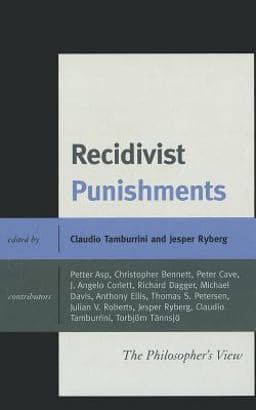
Recidivist Punishments
by Jesper Ryberg (Editor)Claudio Tamburrini (Editor)Peter Asp (Contribution by)Christopher Bennett (Contribution by)Peter Cave (Contribution by)J. Angelo Corlett (Contribution by)Richard Dagger (Contribution by)Michael Davis (Contribution by)Anthony Ellis (Contribution by)Thomas S. Petersen (Contribution by)Julian V. Roberts (Contribution by)Torbjö Tännsjö (Contribution by)
Format: Hardcover
ISBN13: 9780739149966
Hardcover|9780739149966
✨ Featured Offer
Used, Very Good
$85.34
List Price: $121.00
🚚
See all 2 offers from $85.34 FREE standard delivery by: 02 Apr 2026
Overview
In most Western penal systems, recidivist criminals are punished more harshly than first offenders. The philosophical grounds for this response are however difficult to grasp. According to the retributive ideal, recidivists deserve harsher punishments, independently of the eventual effects of the recidivist premium on crime rates. Different notions of "desert" have been advanced in the literature to substantiate this claim. However, all of them have this problem in common: how to justify a harsher punishment of an offender on grounds of a past offence which s/he already paid for?
According to a different approach, it is argued that by sentencing offenders to harsher punishments, particularly longer prison terms, we expect to deter them or other potential criminals from recidivating (individual and general deterrence) or at least we might keep them incapacitated by holding them in prison after the standard punishment has been served.
During the last decade or so, a different approach has been advanced that underlies the communicative function of penal sanctions. Starting from the assumption that the public subscribes a higher degree of blameworthiness to recidivism, it is then argued that this general opinion should be reflected in the penal sanctions if we don't want to risk discrediting the legal system. Finally, it could be argued that, although we don't know for sure how many (if at all) future crimes can be prevented by recidivist premiums, it is not justified to take any risks in that regard, as we would then failing to protect future crime victims. The price for averting this uncertainty should therefore be paid by those who have broken the law in the past, according to these authors. But this can be made by submitting them to non-traditional forms of punishments.
Much has been written about recidivist punishments, particularly within the area of criminology. There is however a notorious lack of (penal) philosophical reflection regarding this issue. In this book, all these different approaches to recidivist punishments are critically discussed with the ambition of filling that gap by presenting the philosophers' view on this matter.
According to a different approach, it is argued that by sentencing offenders to harsher punishments, particularly longer prison terms, we expect to deter them or other potential criminals from recidivating (individual and general deterrence) or at least we might keep them incapacitated by holding them in prison after the standard punishment has been served.
During the last decade or so, a different approach has been advanced that underlies the communicative function of penal sanctions. Starting from the assumption that the public subscribes a higher degree of blameworthiness to recidivism, it is then argued that this general opinion should be reflected in the penal sanctions if we don't want to risk discrediting the legal system. Finally, it could be argued that, although we don't know for sure how many (if at all) future crimes can be prevented by recidivist premiums, it is not justified to take any risks in that regard, as we would then failing to protect future crime victims. The price for averting this uncertainty should therefore be paid by those who have broken the law in the past, according to these authors. But this can be made by submitting them to non-traditional forms of punishments.
Much has been written about recidivist punishments, particularly within the area of criminology. There is however a notorious lack of (penal) philosophical reflection regarding this issue. In this book, all these different approaches to recidivist punishments are critically discussed with the ambition of filling that gap by presenting the philosophers' view on this matter.
| ISBN-13 | 9780739149966 |
|---|---|
| ISBN-10 | 0739149962 |
| Weight | 2.31 Pounds |
| Dimensions | 6.38 x 0.84 x 9.45 In |
| List Price | $121.00 |
| Format | Hardcover |
|---|---|
| Language | English |
| Pages | 234 pages |
| Publisher | Lexington Books |
| Published On | 2011-12-08 |
View All Offers
Sort by:
Price
Condition
Seller
Seller Comments
Price
✨ Used, Very Good
Seller details
Redux Books
Wyoming, MI, USA
Size: 6x0x9; Hardcover. NO DUST JACKET. Pages clean and unmarked. Covers show very minor shelf wea...
Free delivery by: 02 Apr 2026
Used, Good
Seller details
Bonita
Santa Clarita, CA, USA
Access codes and supplements are not guaranteed with used items. May be an ex-library book.
Free delivery by: 02 Apr 2026