
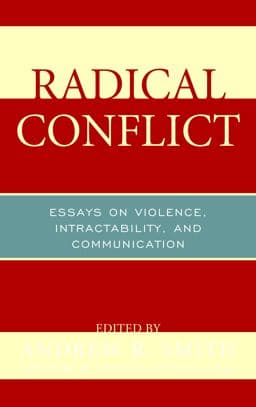
Radical Conflict
by Andrew R. Smith (Editor, Contribution by)Abdullahi Ahmed An-Na'im (Contribution by)Taieb Belghazi (Contribution by)Rebecca J. Welch Cline (Contribution by)Hamdi Echkaou (Contribution by)Donald G. Ellis (Contribution by)Said Graiouid (Contribution by)Jason Hannan (Contribution by)Tanis Hernandez (Contribution by)Anna Klyukanova (Contribution by)Fadoua Loudiy (Contribution by)Andrea L. Meluch (Contribution by)Cleophas Taurai Muneri (Contribution by)Aleksandra Nesic (Contribution by)Phillip R. Reed (Contribution by)Leslie Reynard (Contribution by)Sudeshna Roy (Contribution by)Marya Rozanova-Smith (Contribution by)Greg Greg Russell (Contribution by)Jamal Eddine Slimani (Contribution by)Kristen A. Thomas (Contribution by)
Format:
ISBN13: 9781498521789
|9781498521789
Out of Stock
Overview
Radical Conflictaddresses conflict at interpersonal and communal, legal and rhetorical, ethnopolitical, global, and geopolitical levels. The conflicts analyzed are "radical" because in each some intense and often prolonged violence takes place. The chapters address different kinds of violence(s)--physical and gratuitous, structural and socio-economic, legal and symbolic, all with significant ill effects and injustices that spiral in all directions. All share an interest in exploring imaginatively and speculatively what can be done to attenuate such cycles of violence. The volume analyzes how recurrent narratives, mythologies, media(ted) constructions and other discourse(s) of liberal democratic and authoritarian states play a significant role in exacerbating or thwarting violence, exposing, escalating, legitimizing, rationalizing, propagating, but also possibly mitigating violence in all of its forms.
Each contributor provides a critical interpretation of the status of the conflict under inquiry, including: a teacher verbally abusing and ridiculing a student then exposing it in social media; a community torn apart by environmental disaster; the incommensurate but not incommensurable conflict between Israelis and Palestinians; the Muslim Brotherhood and the militarized state(s) of Egypt and Libya; urban discourses in cyberspace among Moroccan and Maghreb youth that have become counter-signifying publics against oppression of the state; the role of media and violence in Zimbabwe's political struggle; the impact of the Circassian diaspora in global politics especially in the United States; India's soft power approach to the Kashmir conflict as a way to capitalize on it through tourism; the agonistic discourses that pervade the conflict over the Sahara and deprive Sahrawi people of rights; and how the liberal state is implicated in the gratuitous violence of ISIL.
The volume also offers a section on the rhetoric of exclusionary laws associated with intractable conflicts of the abortion conflict, the right to die controversy, and a Burkean perspective on violence in Bangladesh. Contributors suggest what can be done conceptually and politically to mitigate and end violations of those who are most vulnerable, banished, forgotten, damaged, and often silenced.
Each contributor provides a critical interpretation of the status of the conflict under inquiry, including: a teacher verbally abusing and ridiculing a student then exposing it in social media; a community torn apart by environmental disaster; the incommensurate but not incommensurable conflict between Israelis and Palestinians; the Muslim Brotherhood and the militarized state(s) of Egypt and Libya; urban discourses in cyberspace among Moroccan and Maghreb youth that have become counter-signifying publics against oppression of the state; the role of media and violence in Zimbabwe's political struggle; the impact of the Circassian diaspora in global politics especially in the United States; India's soft power approach to the Kashmir conflict as a way to capitalize on it through tourism; the agonistic discourses that pervade the conflict over the Sahara and deprive Sahrawi people of rights; and how the liberal state is implicated in the gratuitous violence of ISIL.
The volume also offers a section on the rhetoric of exclusionary laws associated with intractable conflicts of the abortion conflict, the right to die controversy, and a Burkean perspective on violence in Bangladesh. Contributors suggest what can be done conceptually and politically to mitigate and end violations of those who are most vulnerable, banished, forgotten, damaged, and often silenced.
| ISBN-13 | 9781498521789 |
|---|---|
| ISBN-10 | 1498521789 |
| Format | - |
|---|---|
| Language | English |
| Pages | 336 pages |
| Publisher | |
| Published On | 2016-05-15 |
View All Offers
Sort by:
Price