
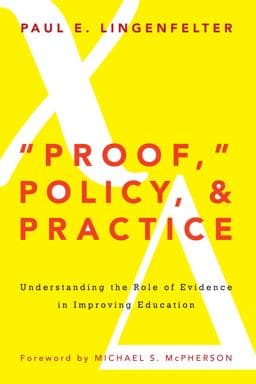
Proof, Policy, and Practice
Format: Paperback
ISBN13: 9781579227517
Paperback|9781579227517
✨ Featured Offer
Used, Like New
$14.52
List Price: $39.95
🚚
See all 5 offers from $7.64 FREE standard delivery by: 05 Apr 2026
Overview
How can we "fix" our schools? Improve graduation rates in college? What works?
These are questions that make the headlines and vex policy makers, practitioners, and educational researchers. While they strive to improve society, there are frequently gulfs of mutual incomprehension among them.
Academics, longing for more influence, may wrongly fault irrationality, ideology, or ignorance for the failure of research to inform policy and practice more powerfully. Policy makers and practitioners may doubt that academics can deliver ideas that will reliably yield desirable results.
This book bridges the divide. It argues that unrealistic expectations lead to both unproductive research and impossible standards for "evidence-based" policy and practice, and it offers promising ways for evidence to contribute to improvement. It analyzes the utility and limitations of the different research methods that have been applied to policy and practice, as well as the strengths and weaknesses of educational reform strategies. It explains why using evidence for "accountability" often makes things worse rather than better.
Paul Lingenfelter offers educational researchers and policy makers a framework for considering such questions as: What problems are important and accessible? What methods will be fruitful? Which help policy makers and practitioners make choices and learn how to improve? What information is relevant? What knowledge is valid and useful? How can policy makers and practitioners establish a more productive division of labor based on their respective capabilities and limitations?
He cautions against the illusion that straight-forward scientific approaches and data can be successfully applied to society's most complex problems. While explaining why no single policy or intervention can solve complex problems, he concludes that determination, measurement, analysis, and adaptation based on evidence in specific situations can lead to significant improvement.
This positive, even-handed introduction to the use of research for problem-solving concludes by suggesting emerging practices and approaches that can help scholars, practitioners, and policy leaders become more successful in reaching their fundamental goals.
These are questions that make the headlines and vex policy makers, practitioners, and educational researchers. While they strive to improve society, there are frequently gulfs of mutual incomprehension among them.
Academics, longing for more influence, may wrongly fault irrationality, ideology, or ignorance for the failure of research to inform policy and practice more powerfully. Policy makers and practitioners may doubt that academics can deliver ideas that will reliably yield desirable results.
This book bridges the divide. It argues that unrealistic expectations lead to both unproductive research and impossible standards for "evidence-based" policy and practice, and it offers promising ways for evidence to contribute to improvement. It analyzes the utility and limitations of the different research methods that have been applied to policy and practice, as well as the strengths and weaknesses of educational reform strategies. It explains why using evidence for "accountability" often makes things worse rather than better.
Paul Lingenfelter offers educational researchers and policy makers a framework for considering such questions as: What problems are important and accessible? What methods will be fruitful? Which help policy makers and practitioners make choices and learn how to improve? What information is relevant? What knowledge is valid and useful? How can policy makers and practitioners establish a more productive division of labor based on their respective capabilities and limitations?
He cautions against the illusion that straight-forward scientific approaches and data can be successfully applied to society's most complex problems. While explaining why no single policy or intervention can solve complex problems, he concludes that determination, measurement, analysis, and adaptation based on evidence in specific situations can lead to significant improvement.
This positive, even-handed introduction to the use of research for problem-solving concludes by suggesting emerging practices and approaches that can help scholars, practitioners, and policy leaders become more successful in reaching their fundamental goals.
| ISBN-13 | 9781579227517 |
|---|---|
| ISBN-10 | 1579227511 |
| Weight | 0.84 Pounds |
| Dimensions | 6.00 x 0.80 x 8.90 In |
| List Price | $39.95 |
| Format | Paperback |
|---|---|
| Language | English |
| Pages | 264 pages |
| Publisher | Stylus Publishing |
| Published On | 2015-12-17 |
View All Offers
Sort by:
Price
Condition
Seller
Seller Comments
Price
Used, Good
Seller details
HPB-Red
Dallas, TX, USA
Connecting readers with great books since 1972! Used textbooks may not include companion materials s...
Free delivery by: 05 Apr 2026
Used, Very Good
Seller details
HPB Inc.
Dallas, TX, USA
Connecting readers with great books since 1972! Used books may not include companion materials, and ...
Free delivery by: 05 Apr 2026
Used, Very Good
Seller details
HPB-Diamond
Dallas, TX, USA
Connecting readers with great books since 1972! Used books may not include companion materials, and ...
Free delivery by: 05 Apr 2026
✨ Used, Like New
Seller details
Books From California
Simi Valley, CA, USA
As New Condition-Over 500, 000 Internet Orders Shipped.
Free delivery by: 05 Apr 2026
Used, Like New
Seller details
GreatBookPrices-
Columbia, MD, USA
100% Money Back Guarantee. Brand New, Perfect Condition. We offer expedited shipping to all US locat...
Free delivery by: 05 Apr 2026