
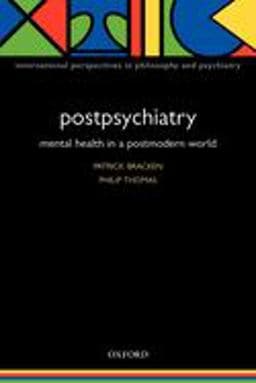
Postpsychiatry
Format: Paperback
ISBN13: 9780198526094
Paperback|9780198526094
✨ Featured Offer
Brand New
$114.27
List Price: $110.00
🚚
See all 5 offers from $11.85 FREE standard delivery by: 01 Apr 2026
Overview
How are we to make sense of madness and psychosis? For most of us the words conjure up images from television and newspapers of seemingly random, meaningless violence. It is something to be feared, something to be left to the experts. But is madness best thought of as a medical condition? Psychiatrists and the drug industry maintain that psychoses are brain disorders amenable to treatment with drugs, but is this actually so? There is no convincing evidence that the brain is disordered in psychosis, yet governments across the world are investing huge sums of money on mental health services that take for granted the idea that psychosis is an illness to be treated with medication. Although some people who use mental health services find medication helpful, many do not, and resist the idea that their experiences are symptoms of illnesses like schizophrenia. Consequently they are forced into having treatment against their wishes. So, how do we make sense of this situation? Postpsychiatry addresses these questions. It involves an attempt to rethink some of the fundamental assumptions of mental health work, showing how recent developments in philosophy and ethics can help us to clarify some of the dilemmas and conflicts around different understandings of madness. Throughout, the authors examine the conflicting ways in which politicians, academics, and mental health professionals appear to understand madness, and contrast this with voices and experiences that are usually excluded - those of the people who use mental health services. They then examine the power of psychiatry to shape how we understand ourselves and our emotions, before considering some of the basic limitations of psychiatry as science to make madness meaningful. In the final section of the book they draw on evidence from service users and survivors, the humanities and anthropology, to point out a new direction for mental health practice. This new direction emphasises the importance of cultural contexts in understanding madness, placing ethics before technology in responding to madness, and minimising 'therapeutic' coercion.
| ISBN-13 | 9780198526094 |
|---|---|
| ISBN-10 | 0198526091 |
| Weight | 1.10 Pounds |
| Dimensions | 6.25 x 0.72 x 9.25 In |
| List Price | $110.00 |
| Edition | 1st Edition |
| Format | Paperback |
|---|---|
| Language | English |
| Pages | 312 pages |
| Publisher | Oxford University Press |
| Published On | 2006-02-16 |
View All Offers
Sort by:
Price
Condition
Seller
Seller Comments
Price
Used, Like New
Seller details
Zoom Books Company
Lynden, WA, USA
Free delivery by: 01 Apr 2026
Used, Very Good
Seller details
Book Alley
Pasadena, CA, USA
Gently used, no markings.
Free delivery by: 01 Apr 2026
Used, Good
Seller details
Bonita
Santa Clarita, CA, USA
Access codes and supplements are not guaranteed with used items. May be an ex-library book.
Free delivery by: 01 Apr 2026
Used, Like New
Seller details
GreatBookPrices-
Columbia, MD, USA
100% Money Back Guarantee. Brand New, Perfect Condition. We offer expedited shipping to all US locat...
Free delivery by: 01 Apr 2026
✨ Brand New
Seller details
GreatBookPrices-
Columbia, MD, USA
100% Money Back Guarantee. Brand New, Perfect Condition. We offer expedited shipping to all US locat...
Free delivery by: 01 Apr 2026