
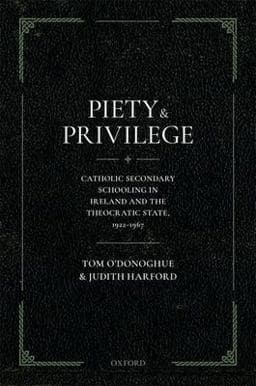
Piety and Privilege
Format: Hardcover
ISBN13: 9780192843166
Hardcover|9780192843166
Out of Stock
Overview
For centuries, the Catholic Church around the world insisted it had a right to provide and organize its own schools. It decreed also that while nation states could lay down standards for secular curricula, pedagogy, and accommodation, Catholic parents should send their children to Catholicschools and be able to do so without suffering undue financial disadvantage. Thus, from the Pope down, the Church expressed deep opposition to increasing state intervention in schooling, especially during the nineteenth century. By the end of the 1920s however, it was satisfied with the schoolsystem in only a small number of countries. Ireland was one of those. There, the majority of primary and secondary schools were Catholic schools. The State left their management in the hands of clerics while simultaneously accepting financial responsibility for maintenance and teachers' salaries.During the period 1922-1967, the Church, unhindered by the State, promoted within the schools' practices aimed at 'the salvation of souls' and at the reproduction of a loyal middle class and clerics. The State supported that arrangement with the Church also acting on its behalf in aiming to producea literate and numerate citizenry, in pursuing nation building, and in ensuring the preparation of an adequate number of secondary school graduates to address the needs of the public service and the professions. All of that took place at a financial cost much lower than the provision of a totallyState-funded system of schooling would have entailed. Piety and Privilege seeks to understand the dynamic between Church and State through the lens of the twentieth century Irish education system.
| ISBN-13 | 9780192843166 |
|---|---|
| ISBN-10 | 0192843168 |
| Weight | 1.20 Pounds |
| Dimensions | 6.50 x 0.75 x 9.50 In |
| List Price | $105.00 |
| Format | Hardcover |
|---|---|
| Language | English |
| Pages | 256 pages |
| Publisher | Oxford University Press |
| Published On | 2022-03-14 |
View All Offers
Sort by:
Price