
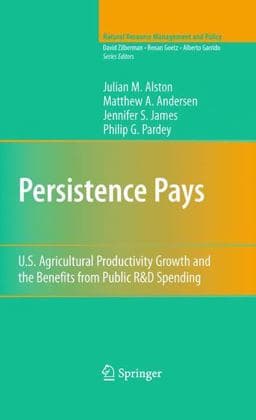
Persistence Pays
Format: Paperback
ISBN13: 9781461425236
Paperback|9781461425236
✨ Featured Offer
Brand New
$221.48
List Price: $219.99
🚚
See all 1 offers from $221.48 FREE standard delivery by: 29 Mar 2026
Overview
gricultural science policy in the United States has profoundly affected the growth and development of agriculture worldwide, not just in the A United States. Over the past 150 years, and especially over the second th half of the 20 Century, public investments in agricultural R&D in the United States grew faster than the value of agricultural production. Public spending on agricultural science grew similarly in other more-developed countries, and c- lectively these efforts, along with private spending, spurred agricultural prod- tivity growth in rich and poor nations alike. The value of this investment is seldom fully appreciated. The resulting p- ductivity improvements have released labor and other resources for alternative uses--in 1900, 29. 2 million Americans (39 percent of the population) were - rectly engaged in farming compared with just 2. 9 million (1. 1 percent) today-- while making food and fiber more abundant and cheaper. The benefits are not confined to Americans. U. S. agricultural science has contributed with others to growth in agricultural productivity in many other countries as well as the Un- ed States. The world's population more than doubled from around 3 billion in 1961 to 6. 54 billion in 2006 (U. S. Census Bureau 2009). Over the same period, production of important grain crops (including maize, wheat and rice) almost trebled, such that global per capita grain production was 18 percent higher in 2006.
| ISBN-13 | 9781461425236 |
|---|---|
| ISBN-10 | 1461425239 |
| Weight | 1.64 Pounds |
| Dimensions | 6.10 x 1.21 x 9.25 In |
| List Price | $219.99 |
| Edition | 1st Edition |
| Format | Paperback |
|---|---|
| Language | English |
| Pages | xxxii, 504 pages |
| Publisher | Springer |
| Published On | 2012-02-25 |
View All Offers
Sort by:
Price
Condition
Seller
Seller Comments
Price
✨ Brand New
Seller details
Alibris
Sparks, NV, USA
Print on demand Trade paperback (US). Glued binding. 504 p. Contains: Illustrations, black & white....
Free delivery by: 29 Mar 2026