
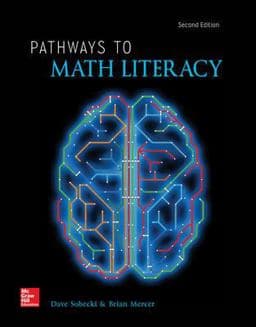
Pathways to Math Literacy (LooseLeaf)
Format:
ISBN13: 9781259985607
|9781259985607
✨ Featured Offer
Brand New
$12.44
List Price: $143.79
🚚
See all 7 offers from $9.74 FREE standard delivery by: 26 Mar 2026
Overview
Pathways to Math Literacy, 2nd EditionUnit 1: Organizing and Visualizing Numeric Data
Lesson 1-1: Where Does the Time Go? (Percentages, Pie Charts, and Bar Graphs)
Objective 1: Analyze personal time management for a week of activities.
Objective 2: Solve problems involving percentages.
Objective 3: Create and interpret pie charts.
Objective 4: Create and interpret bar graphs.
Lesson 1-2: Do You Have Anything To Add? (Using Addition and Subtraction Skills)
Objective 1: Identify circumstances where addition or subtraction is possible. Objective 2: Add or subtract quantities.
Lesson 1-3: It''s About Accumulation (Using Multiplication and Division Skills)
Objective 1: Interpret multiplication as repeated addition.
Objective 2: Multiply or divide quantities.
Lesson 1-4: Avoiding Empty Pockets (Using Exponents and Order of Operation)
Objective 1: Distinguish between simple interest and compound interest.
Objective 2: Distinguish between linear and exponential growth.
Objective 3: Interpret exponents as repeated multiplication.
Objective 4: Simplify numeric expressions involving exponents and the order of operations.
Lesson 1-5: A Coordinated Effort (The Basics of Graphing) Objective 1: Use a rectangular coordinate system.
Objective 2: Connect data to graphs.
Objective 3: Interpret graphs.
Lesson 1-6: What are the Chances? (Basic Probability)
Objective 1: Compute and interpret basic probabilities.
Objective 2: Translate a probability to a percent chance.
Objective 3: Recognize the difference between theoretical and empirical probability.
Lesson 1-7: Debt: Bad, Chocolate: Good (Using Scientific Notation)
Objective 1: Convert numbers between decimal and scientific notation.
Objective 2: Describe the significance of writing numbers in scientific notation.
Lesson 1-8: What''s Your Type? (Organizing Information with Venn Diagrams) Objective 1: Analyze how your personality type affects how you interact with others.
Objective 2: Create and interpret Venn diagrams.
Objective 3: Describe sets using appropriate terminology.
Lesson 1-9: News in the Data Age (Gathering and Organizing Data)
Objective 1: Explain the difference between a population and a sample.
Objective 2: Organize data with frequency distributions and histograms.
Objective 3: Analyze data with stem and leaf plots.
Unit 2: Making Sense of It All
Lesson 2-1: Did You Pass the Test? (Using Measures of Average)
Objective 1: Consider strategies for preparing for and taking math tests.
Objective 2: Understand the impact of a single question, or a single exam.
Objective 3: Calculate, interpret, and compare measures of average.
Lesson 2-2: Ins and Outs (Inputs, Outputs, and Interpreting Expressions)
Objective 1: Distinguish between inputs (independent variables) and outputs (dependent variables).
Objective 2: Evaluate expressions and formulas.
Objective 3: Write and interpret expressions.
Lesson 2-3: From Another Dimension (Working with Units and Formulas)
Objective 1: Determine units for area and volume calculations.
Objective 2: Use formulas to calculate areas and volumes.
Objective 3: Discuss important skills for college students to have.
Objective 4: Simplify expressions. Lesson 2-4: It Works like Magic (Dimensional Analysis)
Objective 1: Convert units using dimensional analysis.
Objective 2: Convert units within the metric system.
Objective 3: Convert rates of change.
Objective 4: Convert temperatures.
Lesson 2-5: Take a Guess! (Estimation and Number Sense)
Objective 1: Identify the steps in a systematic problem-solving procedure.
Objective 2: Make educated guesses.
Objective 3: Compare numbers using inequality symbols.
Lesson 2-6: It''s All Relative (Interpreting Relative Change/Percent Error)
Objective 1: Compare change to relative change.
Objective 2: Apply percent error.
Lesson 2-7: Is that Normal? (Standard Deviation and Normal Distributions)
Objective 1: Identify the steps in computing standard deviation, and describe why they lead to a measure of variation.
Objective 2: Compute and interpret standard deviation.
Objective 3: Use a normal distribution to find probabilities.
Lesson 2-8: Meeting Expectations (Expected Value and Weighted Averages) Objective 1: Estimate expected value experimentally.
Objective 2: Compute expected value.
Objective 3: Compute weighted grades and GPA.
Unit 3: Thinking Linearly
Lesson 3-1: 88 Miles Per Hour! (Slope as a Rate of Change)
Objective 1: Interpret a rate of change.
Objective 2: Predict a future value from a rate of change.
Objective 3: Calculate a rate of change.
Objective 4: Find the intercepts of a line.
Objective 5: Interpret the meaning of the intercepts of a line.
Lesson 3-2: A Snow Job (Writing, Interpreting, and Evaluating Algebraic Expressions)
Objective 1: Write expressions based on given information.
Objective 2: Interpret algebraic expressions in context.
Objective 3: Evaluate and simplify expressions.
Lesson 3-3: All Things Being Equal (Solving Equations)
Objective 1: Explain what it means to solve an equation.
Objective 2: Demonstrate the procedures for solving a basic linear equation.
Objective 3: Solve a literal equation for a designated variable.
Lesson 3-4: All Quantities Are Not Created Equal (Solving Inequalities)
Objective 1: Demonstrate the procedures for solving a linear inequality.
Objective 2: Solve application problems that involve linear inequalities.
Lesson 3-5: What''s Your Problem? (Solving Problems Numerically and Algebraically)
Objective 1: Solve application problems using numerical calculations.
Objective 2: Solve application problems using linear equations.
Lesson 3-6: Big Mac Exchange Rates (Direct Variation and Proportions)
Objective 1: Identify situations where direct variation occurs.
Objective 2: Write an appropriate direct variation equation for a situation.
Objective 3: Solve an application problem that involves direct variation.
Lesson 3-7: Big Mac Exchange Rates (Direct Variation and Proportions)
Objective 1: Write an equation of a line given a description of the relationship.
Objective 2: Write an equation of a line that models data from a table.
Objective 3: Write an equation of a line from a graph of the line.
Objective 4: Graph a line by plotting points.
Lesson 3-8: Party Planning (Point-Slope Form and Linear Modeling)
Objective 1: Find the y intercept and equation of a line given two points.
Objective 2: Find the equation of a line using point-slope form.
Objective 3: Convert between forms of a linear equation.
Lesson 3-9: The Great Tech Battle (Linear Relationships and Lines of Best Fit)
Objective 1: Determine whether two variables have a linear relationship.
Objective 2: Calculate the line of best fit for a set of data using a spreadsheet.
Objective 3: Calculate the line of best fir for a set of data using a calculator.
Objective 4: Interpret the correlation coefficient for a data set.
Lesson 3-10: All Systems Go (Solving Problems with Systems of Equations)
Objective 1: Solve an application problem involving a system of equations.
Objective 2: Illustrate the solution to a system of equations using a table.
Objective 3: Illustrate the solution to a system of equations using a graph.
Unit 4: Living in a Nonlinear World
Lesson 4-1: Oh Yeah? Prove It (Inductive and Deductive Reasoning)
Objective 1: Apply inductive reasoning to make a conjecture.
Objective 2: Disprove a conjecture by finding a counterexample.
Objective 3: Apply deductive reasoning to solve a problem.
Lesson 4-2: A Road Map to Success (The Pythagorean Theorem and Distance)
Objective 1: Solve application problems using the Pythagorean Theorem.
Objective 2: Solve application problems involving the distance formula.
Lesson 4-3: The Error of Your Ways (Polling and Margin of Error)
Objective 1: Determine the margin of error in a given poll.
Objective 2: Explain the meaning of the margin of error in a given poll.
Objective 3: Calculate the number of poll respondents needed for a given margin of error.
Lesson 4-4: Where''s My Jetpack? (Inverse vs. Direct Variation)
Objective 1: Identify situations where inverse variation occurs.
Objective 2: Solve problems involving direct and inverse variation.
Lesson 1-1: Where Does the Time Go? (Percentages, Pie Charts, and Bar Graphs)
Objective 1: Analyze personal time management for a week of activities.
Objective 2: Solve problems involving percentages.
Objective 3: Create and interpret pie charts.
Objective 4: Create and interpret bar graphs.
Lesson 1-2: Do You Have Anything To Add? (Using Addition and Subtraction Skills)
Objective 1: Identify circumstances where addition or subtraction is possible. Objective 2: Add or subtract quantities.
Lesson 1-3: It''s About Accumulation (Using Multiplication and Division Skills)
Objective 1: Interpret multiplication as repeated addition.
Objective 2: Multiply or divide quantities.
Lesson 1-4: Avoiding Empty Pockets (Using Exponents and Order of Operation)
Objective 1: Distinguish between simple interest and compound interest.
Objective 2: Distinguish between linear and exponential growth.
Objective 3: Interpret exponents as repeated multiplication.
Objective 4: Simplify numeric expressions involving exponents and the order of operations.
Lesson 1-5: A Coordinated Effort (The Basics of Graphing) Objective 1: Use a rectangular coordinate system.
Objective 2: Connect data to graphs.
Objective 3: Interpret graphs.
Lesson 1-6: What are the Chances? (Basic Probability)
Objective 1: Compute and interpret basic probabilities.
Objective 2: Translate a probability to a percent chance.
Objective 3: Recognize the difference between theoretical and empirical probability.
Lesson 1-7: Debt: Bad, Chocolate: Good (Using Scientific Notation)
Objective 1: Convert numbers between decimal and scientific notation.
Objective 2: Describe the significance of writing numbers in scientific notation.
Lesson 1-8: What''s Your Type? (Organizing Information with Venn Diagrams) Objective 1: Analyze how your personality type affects how you interact with others.
Objective 2: Create and interpret Venn diagrams.
Objective 3: Describe sets using appropriate terminology.
Lesson 1-9: News in the Data Age (Gathering and Organizing Data)
Objective 1: Explain the difference between a population and a sample.
Objective 2: Organize data with frequency distributions and histograms.
Objective 3: Analyze data with stem and leaf plots.
Unit 2: Making Sense of It All
Lesson 2-1: Did You Pass the Test? (Using Measures of Average)
Objective 1: Consider strategies for preparing for and taking math tests.
Objective 2: Understand the impact of a single question, or a single exam.
Objective 3: Calculate, interpret, and compare measures of average.
Lesson 2-2: Ins and Outs (Inputs, Outputs, and Interpreting Expressions)
Objective 1: Distinguish between inputs (independent variables) and outputs (dependent variables).
Objective 2: Evaluate expressions and formulas.
Objective 3: Write and interpret expressions.
Lesson 2-3: From Another Dimension (Working with Units and Formulas)
Objective 1: Determine units for area and volume calculations.
Objective 2: Use formulas to calculate areas and volumes.
Objective 3: Discuss important skills for college students to have.
Objective 4: Simplify expressions. Lesson 2-4: It Works like Magic (Dimensional Analysis)
Objective 1: Convert units using dimensional analysis.
Objective 2: Convert units within the metric system.
Objective 3: Convert rates of change.
Objective 4: Convert temperatures.
Lesson 2-5: Take a Guess! (Estimation and Number Sense)
Objective 1: Identify the steps in a systematic problem-solving procedure.
Objective 2: Make educated guesses.
Objective 3: Compare numbers using inequality symbols.
Lesson 2-6: It''s All Relative (Interpreting Relative Change/Percent Error)
Objective 1: Compare change to relative change.
Objective 2: Apply percent error.
Lesson 2-7: Is that Normal? (Standard Deviation and Normal Distributions)
Objective 1: Identify the steps in computing standard deviation, and describe why they lead to a measure of variation.
Objective 2: Compute and interpret standard deviation.
Objective 3: Use a normal distribution to find probabilities.
Lesson 2-8: Meeting Expectations (Expected Value and Weighted Averages) Objective 1: Estimate expected value experimentally.
Objective 2: Compute expected value.
Objective 3: Compute weighted grades and GPA.
Unit 3: Thinking Linearly
Lesson 3-1: 88 Miles Per Hour! (Slope as a Rate of Change)
Objective 1: Interpret a rate of change.
Objective 2: Predict a future value from a rate of change.
Objective 3: Calculate a rate of change.
Objective 4: Find the intercepts of a line.
Objective 5: Interpret the meaning of the intercepts of a line.
Lesson 3-2: A Snow Job (Writing, Interpreting, and Evaluating Algebraic Expressions)
Objective 1: Write expressions based on given information.
Objective 2: Interpret algebraic expressions in context.
Objective 3: Evaluate and simplify expressions.
Lesson 3-3: All Things Being Equal (Solving Equations)
Objective 1: Explain what it means to solve an equation.
Objective 2: Demonstrate the procedures for solving a basic linear equation.
Objective 3: Solve a literal equation for a designated variable.
Lesson 3-4: All Quantities Are Not Created Equal (Solving Inequalities)
Objective 1: Demonstrate the procedures for solving a linear inequality.
Objective 2: Solve application problems that involve linear inequalities.
Lesson 3-5: What''s Your Problem? (Solving Problems Numerically and Algebraically)
Objective 1: Solve application problems using numerical calculations.
Objective 2: Solve application problems using linear equations.
Lesson 3-6: Big Mac Exchange Rates (Direct Variation and Proportions)
Objective 1: Identify situations where direct variation occurs.
Objective 2: Write an appropriate direct variation equation for a situation.
Objective 3: Solve an application problem that involves direct variation.
Lesson 3-7: Big Mac Exchange Rates (Direct Variation and Proportions)
Objective 1: Write an equation of a line given a description of the relationship.
Objective 2: Write an equation of a line that models data from a table.
Objective 3: Write an equation of a line from a graph of the line.
Objective 4: Graph a line by plotting points.
Lesson 3-8: Party Planning (Point-Slope Form and Linear Modeling)
Objective 1: Find the y intercept and equation of a line given two points.
Objective 2: Find the equation of a line using point-slope form.
Objective 3: Convert between forms of a linear equation.
Lesson 3-9: The Great Tech Battle (Linear Relationships and Lines of Best Fit)
Objective 1: Determine whether two variables have a linear relationship.
Objective 2: Calculate the line of best fit for a set of data using a spreadsheet.
Objective 3: Calculate the line of best fir for a set of data using a calculator.
Objective 4: Interpret the correlation coefficient for a data set.
Lesson 3-10: All Systems Go (Solving Problems with Systems of Equations)
Objective 1: Solve an application problem involving a system of equations.
Objective 2: Illustrate the solution to a system of equations using a table.
Objective 3: Illustrate the solution to a system of equations using a graph.
Unit 4: Living in a Nonlinear World
Lesson 4-1: Oh Yeah? Prove It (Inductive and Deductive Reasoning)
Objective 1: Apply inductive reasoning to make a conjecture.
Objective 2: Disprove a conjecture by finding a counterexample.
Objective 3: Apply deductive reasoning to solve a problem.
Lesson 4-2: A Road Map to Success (The Pythagorean Theorem and Distance)
Objective 1: Solve application problems using the Pythagorean Theorem.
Objective 2: Solve application problems involving the distance formula.
Lesson 4-3: The Error of Your Ways (Polling and Margin of Error)
Objective 1: Determine the margin of error in a given poll.
Objective 2: Explain the meaning of the margin of error in a given poll.
Objective 3: Calculate the number of poll respondents needed for a given margin of error.
Lesson 4-4: Where''s My Jetpack? (Inverse vs. Direct Variation)
Objective 1: Identify situations where inverse variation occurs.
Objective 2: Solve problems involving direct and inverse variation.
| ISBN-13 | 9781259985607 |
|---|---|
| ISBN-10 | 1259985601 |
| Weight | 2.70 Pounds |
| Dimensions | 8.40 x 0.85 x 10.80 In |
| List Price | $143.79 |
| Edition | 2nd Edition |
| Format | - |
|---|---|
| Pages | 1312 pages |
| Publisher | McGraw Hill |
| Published On | 2018-01-09 |
View All Offers
Sort by:
Price
Condition
Seller
Seller Comments
Price
Used, Good
Seller details
HPB-Red
Dallas, TX, USA
Connecting readers with great books since 1972! Used textbooks may not include companion materials s...
Free delivery by: 29 Mar 2026
Used, Good
Seller details
HPB-Red
Dallas, TX, USA
Connecting readers with great books since 1972! Used textbooks may not include companion materials s...
Free delivery by: 29 Mar 2026
Used, Good
Seller details
HPB-Red
Dallas, TX, USA
Connecting readers with great books since 1972! Used textbooks may not include companion materials s...
Free delivery by: 29 Mar 2026
Used, Good
Seller details
HPB-Red
Dallas, TX, USA
Connecting readers with great books since 1972! Used textbooks may not include companion materials s...
Free delivery by: 29 Mar 2026
✨ Brand New
Seller details
Apex_media🍏
Free delivery by: 26 Mar 2026
Used, Very Good
Seller details
FirstClassBooks
Little Rock, AR, USA
Free delivery by: 29 Mar 2026
Brand New
Seller details
Bookstores.com
Free delivery by: 26 Mar 2026