
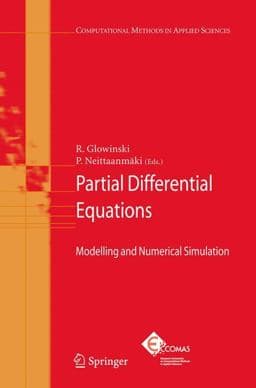
Partial Differential Equations
Format: Paperback
ISBN13: 9789048179794
Paperback|9789048179794
✨ Featured Offer
Brand New
$182.02
List Price: $179.99
🚚
See all 1 offers from $182.02 FREE standard delivery by: 01 Apr 2026
Overview
For more than 250 years partial di?erential equations have been clearly the most important tool available to mankind in order to understand a large variety of phenomena, natural at ?rst and then those originating from - man activity and technological development. Mechanics, physics and their engineering applications were the ?rst to bene?t from the impact of partial di?erential equations on modeling and design, but a little less than a century ago the Schr¨ odinger equation was the key opening the door to the application of partial di?erential equations to quantum chemistry, for small atomic and molecular systems at ?rst, but then for systems of fast growing complexity. The place of partial di?erential equations in mathematics is a very particular one: initially, the partial di?erential equations modeling natural phenomena were derived by combining calculus with physical reasoning in order to - press conservation laws and principles in partial di?erential equation form, leading to the wave equation, the heat equation, the equations of elasticity, the Euler and Navier-Stokes equations for ?uids, the Maxwell equations of electro-magnetics, etc. It is in order to solve 'constructively' the heat equation that Fourier developed the series bearing his name in the early 19th century; Fourier series (and later integrals) have played (and still play) a fundamental roleinbothpureandappliedmathematics,includingmanyareasquiteremote from partial di?erential equations. On the other hand, several areas of mathematics such as di?erential ge- etry have bene?ted from their interactions with partial di?erential equations.
| ISBN-13 | 9789048179794 |
|---|---|
| ISBN-10 | 9048179793 |
| Weight | 0.95 Pounds |
| Dimensions | 6.10 x 0.70 x 9.25 In |
| List Price | $179.99 |
| Edition | 1st Edition |
| Format | Paperback |
|---|---|
| Language | English |
| Pages | xvi, 292 pages |
| Publisher | Springer |
| Published On | 2010-11-25 |
View All Offers
Sort by:
Price
Condition
Seller
Seller Comments
Price
✨ Brand New
Seller details
Alibris
Sparks, NV, USA
Print on demand Computational Methods in Applied Sciences . XVI, 292 p. Intended for professional a...
Free delivery by: 01 Apr 2026