
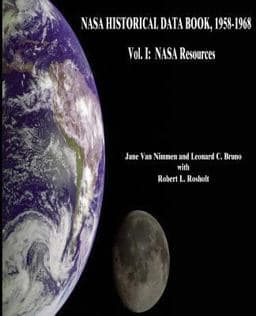
NASA Historical Data Book, 1958-1968
Format: Paperback
ISBN13: 9781501061479
Paperback|9781501061479
✨ Featured Offer
Brand New
$29.84
List Price: $29.99
🚚
See all 3 offers from $29.84 FREE standard delivery by: 02 Apr 2026
Overview
A decade in the life of an organization as dynamic and multifaceted as the National Aeronautics and Space Administration offers a large enough canvas to discern clearly the patterns and trends of the organization's life. For NASA, the decade which closed on October 1, 1968, was its first. That decade has been-and will continue to be-studied by many people and from many perspectives. It is with the hope of stimulating such studies that NASA is offering the NASA Historical Data Book, 1958-1968, of which this volume, NASA Resources, is the first. The intent of the series is to provide a comprehensive, factual data base on the tangible aspects of NASA and its programs. The first volume covers organization and management; the second will cover the individual space and aeronautics programs. This volume deals primarily with the resources which the Nation made available to NASA in that decade and traces the allocation of those resources. The perceptive eye will find much of NASA history and management philosophy, as well as many decisions, reflected in these columns of numbers. In the 1958-1961 period, there is evidence of the piecing together of a new agency to continue research in aeronautics while undertaking the leadership of the Nation's civilian space program. This involved the assimilating of organization, facilities, program, and people from a number of Government agencies and creating out of them a new organization and program. From 1961 to 1966, one can trace the national commitment to an expanded space program, expressed in the doubling and redoubling of resources and the growing momentum. In the 1967-1968 period, the lower costs mark the shift in the Apollo program from development and procurement into its operational phase. This was the decade in which the United States made its commitment to space exploration and demonstrated its capacity to achieve large and difficult goals in a sustained, orderly, and open program. From a historical point of view, in the short period of a decade, the exploration of the space frontier was generating a new Copernican Revolution in our perception of ourselves and our earth. The achievements in space sciences were sparking a rethinking of the educational curriculum. Communications and meteorological satellites progressed from experiment to global systems bringing important daily benefits to people on earth. Growing perception of this national capacity to mobilize, coupled with that other legacy from Apollo-the picture of our beautiful, fragile planet as "spaceship earth"-may in the long view of history rank as even more significant than its tremendous achievements in technology and science.
| ISBN-13 | 9781501061479 |
|---|---|
| ISBN-10 | 150106147X |
| Weight | 2.08 Pounds |
| Dimensions | 7.52 x 1.13 x 9.25 In |
| List Price | $29.99 |
| Format | Paperback |
|---|---|
| Language | English |
| Pages | 556 pages |
| Publisher | CreateSpace Independent Publishing Platform |
| Published On | 2014-09-05 |
View All Offers
Sort by:
Price
Condition
Seller
Seller Comments
Price
✨ Brand New
Seller details
Alibris
Sparks, NV, USA
Print on demand Trade paperback (US). Glued binding. 556 p. NASA Historical.
Free delivery by: 02 Apr 2026
Brand New
Seller details
GreatBookPrices-
Columbia, MD, USA
100% Money Back Guarantee. Brand New, Perfect Condition. We offer expedited shipping to all US locat...
Free delivery by: 02 Apr 2026
Used, Good
Seller details
Bonita
Santa Clarita, CA, USA
Access codes and supplements are not guaranteed with used items. May be an ex-library book.
Free delivery by: 02 Apr 2026