
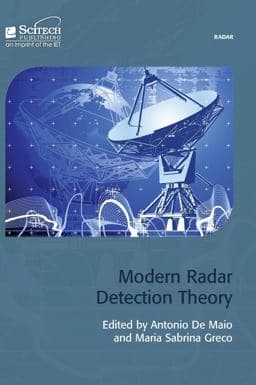
Modern Radar Detection Theory
Format: Hardcover
ISBN13: 9781613531990
✨ Featured Offer
Brand New
$124.62
List Price: $155.00
FREE standard delivery by: 03 Apr 2026
Overview
Recently, various algorithms for radar signal detection that rely heavily upon complicated processing and/or antenna architectures have been the subject of much interest. These techniques owe their genesis to several factors. One is revolutionary technological advances in high-speed signal processing hardware and digital array radar technology. Another is the stress on requirements often imposed by defence applications in areas such as airborne early warning and homeland security.
This book explores these emerging research thrusts in radar detection with advanced radar systems capable of operating in challenging scenarios with a plurality of interference sources, both man-made and natural. Topics covered include: adaptive radar detection in Gaussian interference with unknown spectral properties; invariance theory as an instrument to force the Constant False Alarm Rate (CFAR) property at the design stage; one- and two-stage detectors and their performances; operating scenarios where a small number of training data for spectral estimation is available; Bayesian radar detection to account for prior information in the interference covariance matrix; and radar detection in the presence of non-Gaussian interference. Detector design techniques based on a variety of criteria are thoroughly presented and CFAR issues are discussed. Performance analyses representative of practical airborne, as well as ground-based and shipborne, radar situations are shown.
Results on real radar data are also discussed. Modern Radar Detection Theory provides a comprehensive reference on the latest developments in adaptive radar detection for researchers, advanced students and engineers working on statistical signal processing and its applications to radar systems.
arios where a small number of training data for spectral estimation is available; Bayesian radar detection to account for prior information in the interference covariance matrix; and radar detection in the presence of non-Gaussian interference. Detector design techniques based on a variety of criteria are thoroughly presented and CFAR issues are discussed. Performance analyses representative of practical airborne, as well as ground-based and shipborne, radar situations are shown.Results on real radar data are also discussed. Modern Radar Detection Theory provides a comprehensive reference on the latest developments in adaptive radar detection for researchers, advanced students and engineers working on statistical signal processing and its applications to radar systems.
arios where a small number of training data for spectral estimation is available; Bayesian radar detection to account for prior information in the interference covariance matrix; and radar detection in the presence of non-Gaussian interference. Detector design techniques based on a variety of criteria are thoroughly presented and CFAR issues are discussed. Performance analyses representative of practical airborne, as well as ground-based and shipborne, radar situations are shown.Results on real radar data are also discussed. Modern Radar Detection Theory provides a comprehensive reference on the latest developments in adaptive radar detection for researchers, advanced students and engineers working on statistical signal processing and its applications to radar systems.
arios where a small number of training data for spectral estimation is available; Bayesian radar detection to account for prior information in the interference covariance matrix; and radar detection in the presence of non-Gaussian interference. Detector design techniques based on a variety of criteria are thoroughly presented and CFAR issues are discussed. Performance analyses representative of practical airborne, as well as ground-based and shipborne, radar situations are shown.Results on real radar data are also discussed. Modern Radar Detection Theory provides a comprehensive reference on the latest developments in adaptive radar detection for researchers, advanced students and engineers working on statistical signal processing and its applications to radar systems.
n the presence of non-Gaussian interference. Detector design techniques based on a variety of criteria are thoroughly presented and CFAR issues are discussed. Performance analyses representative of practical airborne, as well as ground-based and shipborne, radar situations are shown.Results on real radar data are also discussed. Modern Radar Detection Theory provides a comprehensive reference on the latest developments in adaptive radar detection for researchers, advanced students and engineers working on statistical signal processing and its applications to radar systems.
| ISBN-13 | 9781613531990 |
|---|---|
| ISBN-10 | 1613531990 |
| Weight | 2.05 Pounds |
| Dimensions | 7.30 x 1.00 x 10.20 In |
| List Price | $155.00 |
| Format | Hardcover |
|---|---|
| Language | English |
| Pages | 400 pages |
| Publisher | Scitech Publishing |
| Published On | 2015-11-25 |
View All Offers
Sort by:
Seller details
Sparks, NV, USA
Free delivery by: 03 Apr 2026
Seller details
Columbia, MD, USA
Free delivery by: 03 Apr 2026
Seller details
Columbia, MD, USA
Free delivery by: 03 Apr 2026