
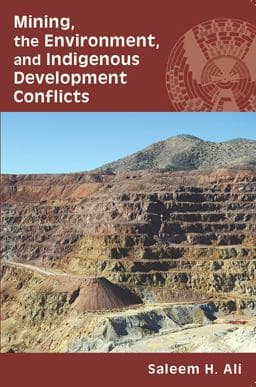
Mining, the Environment, and Indigenous Development Conflicts
Format: Paperback
ISBN13: 9780816528790
Paperback|9780816528790
✨ Featured Offer
Brand New
$43.05
List Price: $32.95
🚚
See all 5 offers from $10.20 FREE standard delivery by: 02 Apr 2026
Overview
From sun-baked Black Mesa to the icy coast of Labrador, native lands for decades have endured mining ventures that have only lately been subject to environmental laws and a recognition of treaty rights. Yet conflicts surrounding mining development and indigenous peoples continue to challenge policy-makers.
This book gets to the heart of resource conflicts and environmental impact assessment by asking why indigenous communities support environmental causes in some cases of mining development but not in others. Saleem Ali examines environmental conflicts between mining companies and indigenous communities and with rare objectivity offers a comparative study of the factors leading to those conflicts.
Mining, the Environment, and Indigenous Development Conflicts presents four cases from the United States and Canada: the Navajos and Hopis with Peabody Coal in Arizona; the Chippewas with the Crandon Mine proposal in Wisconsin; the Chipewyan Inuits, Déné and Cree with Cameco in Saskatchewan; and the Innu and Inuits with Inco in Labrador. These cases exemplify different historical relationships with government and industry and provide an instance of high and low levels of Native resistance in each country. Through these cases, Ali analyzes why and under what circumstances tribes agree to negotiated mining agreements on their lands, and why some negotiations are successful and others not.
Ali challenges conventional theories of conflict based on economic or environmental cost-benefit analysis, which do not fully capture the dynamics of resistance. He proposes that the underlying issue has less to do with environmental concerns than with sovereignty, which often complicates relationships between tribes and environmental organizations. Activist groups, he observes, fail to understand such tribal concerns and often have problems working with tribes on issues where they may presume a common environmental interest.
This book goes beyond popular perceptions of environmentalism to provide a detailed picture of how and when the concerns of industry, society, and tribal governments may converge and when they conflict. As demands for domestic energy exploration increase, it offers clear guidance for such endeavors when native lands are involved.
This book gets to the heart of resource conflicts and environmental impact assessment by asking why indigenous communities support environmental causes in some cases of mining development but not in others. Saleem Ali examines environmental conflicts between mining companies and indigenous communities and with rare objectivity offers a comparative study of the factors leading to those conflicts.
Mining, the Environment, and Indigenous Development Conflicts presents four cases from the United States and Canada: the Navajos and Hopis with Peabody Coal in Arizona; the Chippewas with the Crandon Mine proposal in Wisconsin; the Chipewyan Inuits, Déné and Cree with Cameco in Saskatchewan; and the Innu and Inuits with Inco in Labrador. These cases exemplify different historical relationships with government and industry and provide an instance of high and low levels of Native resistance in each country. Through these cases, Ali analyzes why and under what circumstances tribes agree to negotiated mining agreements on their lands, and why some negotiations are successful and others not.
Ali challenges conventional theories of conflict based on economic or environmental cost-benefit analysis, which do not fully capture the dynamics of resistance. He proposes that the underlying issue has less to do with environmental concerns than with sovereignty, which often complicates relationships between tribes and environmental organizations. Activist groups, he observes, fail to understand such tribal concerns and often have problems working with tribes on issues where they may presume a common environmental interest.
This book goes beyond popular perceptions of environmentalism to provide a detailed picture of how and when the concerns of industry, society, and tribal governments may converge and when they conflict. As demands for domestic energy exploration increase, it offers clear guidance for such endeavors when native lands are involved.
| ISBN-13 | 9780816528790 |
|---|---|
| ISBN-10 | 0816528799 |
| Weight | 0.87 Pounds |
| Dimensions | 6.13 x 0.70 x 9.25 In |
| List Price | $32.95 |
| Edition | 3rd Edition |
| Format | Paperback |
|---|---|
| Language | English |
| Pages | 254 pages |
| Publisher | University of Arizona Press |
| Published On | 2009-08-15 |
View All Offers
Sort by:
Price
Condition
Seller
Seller Comments
Price
Used, Good
Seller details
Midtown Scholar Bookstore
Harrisburg, PA, USA
Good-Bumped and creased book with tears to the extremities, but not affecting the text block, may ha...
Free delivery by: 02 Apr 2026
Used, Good
Seller details
BooksRun
Philadelphia, PA, USA
It's a well-cared-for item that has seen limited use. The item may show minor signs of wear. All the...
Free delivery by: 02 Apr 2026
Used, Like New
Seller details
GreatBookPrices-
Columbia, MD, USA
100% Money Back Guarantee. Brand New, Perfect Condition. We offer expedited shipping to all US locat...
Free delivery by: 02 Apr 2026
Used, Good
Seller details
Bonita
Santa Clarita, CA, USA
Access codes and supplements are not guaranteed with used items. May be an ex-library book.
Free delivery by: 02 Apr 2026
✨ Brand New
Seller details
GreatBookPrices-
Columbia, MD, USA
100% Money Back Guarantee. Brand New, Perfect Condition. We offer expedited shipping to all US locat...
Free delivery by: 02 Apr 2026