
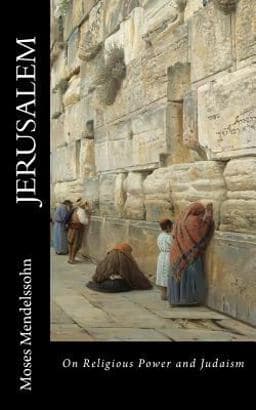
Mendelssohn, Jerusalem
Format: Paperback
ISBN13: 9781985072633
Paperback|9781985072633
✨ Featured Offer
Brand New
$61.75
List Price: $13.00
🚚
See all 3 offers from $13.27 FREE standard delivery by: 04 Apr 2026
Overview
Mendelssohn wrote "Jerusalem" in Prussia on the eve of the French Revolution. When he published "Jerusalem", he risked a lot, not only in front of the Prussian authority, but also in front of religious authorities - including Orthodox Rabbis. Because it deals with social contract and political theory (especially concerning the question of the separation between religion and state). The "Jerusalem" is still underestimated as a contribution to philosophy - probably because it was directly connected with the historical situation and the social conditions of the author's life. On the other hand, a lot of historians concerned about Haskalah criticized the heroic image about Moses Mendelssohn in which he appears as the starting point of Jewish enlightenment without any respect to earlier attempts around the beginning of the 18th century.The "Jerusalem" consisted of two parts and each one was paged separately and the first one treated clearly the contemporary conflicts of the state and the second those of religion. In the first the author developed his political theory towards a utopia of a just and tolerant democracy, which he identified with the political attempt of the Mosaic Law: therefore the title "Jerusalem". In the second part he worked out a new pedagogic charge which every religion has to fulfill in the private sector. It was reduced to it, because the tolerant state should be separated from any religion. Hence the Mosaic law and the traditional practice of jurisdiction was no longer the business of Judaism, if there would be a tolerant state. Instead the new charge of religion would be the education of just and tolerant citizens. The book as a whole summarizes Moses Mendelssohn's critic concerning the contemporary conditions of the Prussian Monarchy and the legal status of the different religions, which finally means the civil status of its inhabitants according to their faith.Jew refusing both proselytism and the abandonment of his own religious beliefs, Moses Mendelssohn opens the way for a dialogue of ideas between the Occident and jusaisme.According to the French philosopher Emmanuel Levinas, "The work of Mendelssohn is in actuality and stimulates Judaism today. In effect, it heralds a new era in Jewish history. It demonstrates that a Judaism's longing to make a symblotic relationship with non-Jewish human world beyond the mythical universalism of being-for-others, which has always been familiar to him."
| ISBN-13 | 9781985072633 |
|---|---|
| ISBN-10 | 1985072637 |
| Weight | 0.52 Pounds |
| Dimensions | 8.00 x 5.00 x 0.41 In |
| List Price | $13.00 |
| Edition | 1st Edition |
| Format | Paperback |
|---|---|
| Language | English |
| Pages | 162 pages |
| Publisher | CreateSpace Independent Publishing Platform |
| Published On | 2018-02-06 |
View All Offers
Sort by:
Price
Condition
Seller
Seller Comments
Price
Used, Very Good
Seller details
Ezekial Books, LLC
Manchester, NH, USA
100% Satisfaction Guaranteed.
Free delivery by: 04 Apr 2026
Used, Good
Seller details
Bonita
Santa Clarita, CA, USA
Access codes and supplements are not guaranteed with used items. May be an ex-library book.
Free delivery by: 04 Apr 2026
✨ Brand New
Seller details
Bonita
Santa Clarita, CA, USA
Free delivery by: 04 Apr 2026