
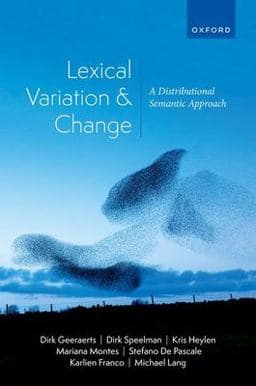
Lexical Variation and Change
Format: Hardcover
ISBN13: 9780198890676
Hardcover|9780198890676
✨ Featured Offer
Brand New
$120.52
List Price: $110.00
🚚
See all 5 offers from $120.52 FREE standard delivery by: 05 Apr 2026
Overview
This is an open access title available under the terms of a CC BY-NC-ND 4.0 International licence. It is free to read at Oxford Academic and offered as a free PDF download from OUP and selected open access locations.
This book introduces a systematic framework for understanding and investigating lexical variation, using a distributional semantics approach. Distributional semantics embodies the idea that the context in which a word occurs reveals the meaning of that word. In contemporary corpus linguistics, that idea takes shape in various types of quantitative analysis of the corpus contexts in which words appear. In this book, the authors explore how count-based token-level semantic vector spaces, as an advanced form of such a quantitative methodology, can be applied to the study of polysemy, lexical variation, and lectometry. What can distributional models reveal about meaning? How can they be used to analyse the semantic relationship between near-synonyms, and to identify strict synonymy? How can they contribute to the study of lexical variation as a sociolinguistic variable, and to the use of those variables to measure convergence or divergence between language varieties? To answer these questions, the book presents a comprehensive model of lexical and semantic variation, based on the combination of a semasiological, an onomasiological, and a lectal dimension. It explains the mechanism of distributional modelling, both informally and technically, and introduces workflows and corpus linguistic tools that implement a distributional perspective in lexical research. Combining a cognitive linguistic interest in meaning with a sociolinguistic interest in variation, the authors illustrate this distributional methodology using case studies of Dutch and Spanish lexical data that focus on the detection of polysemy, the interaction of semasiological and onomasiological change, and sociolinguistic issues of lexical standardization and pluricentricity. Throughout, they highlight both the advantages and disadvantages of a distributional methodology: on the one hand, it has great potential to be scaled up for lexical research; on the other, its outcome does not necessarily neatly correspond with what would traditionally be considered different senses.
This book introduces a systematic framework for understanding and investigating lexical variation, using a distributional semantics approach. Distributional semantics embodies the idea that the context in which a word occurs reveals the meaning of that word. In contemporary corpus linguistics, that idea takes shape in various types of quantitative analysis of the corpus contexts in which words appear. In this book, the authors explore how count-based token-level semantic vector spaces, as an advanced form of such a quantitative methodology, can be applied to the study of polysemy, lexical variation, and lectometry. What can distributional models reveal about meaning? How can they be used to analyse the semantic relationship between near-synonyms, and to identify strict synonymy? How can they contribute to the study of lexical variation as a sociolinguistic variable, and to the use of those variables to measure convergence or divergence between language varieties? To answer these questions, the book presents a comprehensive model of lexical and semantic variation, based on the combination of a semasiological, an onomasiological, and a lectal dimension. It explains the mechanism of distributional modelling, both informally and technically, and introduces workflows and corpus linguistic tools that implement a distributional perspective in lexical research. Combining a cognitive linguistic interest in meaning with a sociolinguistic interest in variation, the authors illustrate this distributional methodology using case studies of Dutch and Spanish lexical data that focus on the detection of polysemy, the interaction of semasiological and onomasiological change, and sociolinguistic issues of lexical standardization and pluricentricity. Throughout, they highlight both the advantages and disadvantages of a distributional methodology: on the one hand, it has great potential to be scaled up for lexical research; on the other, its outcome does not necessarily neatly correspond with what would traditionally be considered different senses.
| ISBN-13 | 9780198890676 |
|---|---|
| ISBN-10 | 0198890672 |
| Weight | 1.45 Pounds |
| Dimensions | 9.10 x 1.70 x 6.50 In |
| List Price | $110.00 |
| Format | Hardcover |
|---|---|
| Language | English |
| Pages | 336 pages |
| Publisher | Oxford University Press |
| Published On | 2024-02-07 |
View All Offers
Sort by:
Price
Condition
Seller
Seller Comments
Price
✨ Brand New
Seller details
indoo.com
Avenel, NJ, USA
9780198890676.
Free delivery by: 05 Apr 2026
Brand New
Seller details
GreatBookPrices-
Columbia, MD, USA
100% Money Back Guarantee. Brand New, Perfect Condition. We offer expedited shipping to all US locat...
Free delivery by: 05 Apr 2026
Brand New
Seller details
Alibris
Sparks, NV, USA
Intended for college/higher education audience.
Free delivery by: 05 Apr 2026
Brand New
Seller details
Paperbackshop
Bensenville, IL, USA
New Book. Shipped from UK in 4 to 14 days. Established seller since 2000. Please note we cannot of...
Free delivery by: 05 Apr 2026
Used, Good
Seller details
Bonita
Santa Clarita, CA, USA
Access codes and supplements are not guaranteed with used items. May be an ex-library book.
Free delivery by: 05 Apr 2026