
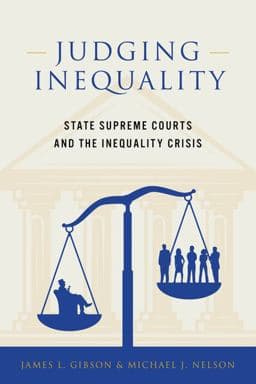
Judging Inequality
Format: Paperback
ISBN13: 9780871545039
Paperback|9780871545039
✨ Featured Offer
Used, Like New
$30.74
List Price: $35.00
🚚
See all 5 offers from $7.01 FREE standard delivery by: 03 Apr 2026
Overview
Social scientists have convincingly documented soaring levels of political, legal, economic, and social inequality in the United States. Missing from this picture of rampant inequality, however, is any attention to the significant role of state law and courts in establishing policies that either ameliorate or exacerbate inequality. In Judging Inequality, political scientists James L. Gibson and Michael J. Nelson demonstrate the influential role of the fifty state supreme courts in shaping the widespread inequalities that define America today, focusing on court-made public policy on issues ranging from educational equity and adequacy to LGBT rights to access to justice to worker's rights.
Drawing on an analysis of an original database of nearly 6,000 decisions made by over 900 judges on 50 state supreme courts over a quarter century, Judging Inequality documents two ways that state high courts have crafted policies relevant to inequality: through substantive policy decisions that fail to advance equality and by rulings favoring more privileged litigants (typically known as "upperdogs"). The authors discover that whether court-sanctioned policies lead to greater or lesser inequality depends on the ideologies of the justices serving on these high benches, the policy preferences of their constituents (the people of their state), and the institutional structures that determine who becomes a judge as well as who decides whether those individuals remain in office.
Gibson and Nelson decisively reject the conventional theory that state supreme courts tend to protect underdog litigants from the wrath of majorities. Instead, the authors demonstrate that the ideological compositions of state supreme courts most often mirror the dominant political coalition in their state at a given point in time. As a result, state supreme courts are unlikely to stand as an independent force against the rise of inequality in the United States, instead making decisions compatible with the preferences of political elites already in power. At least at the state high court level, the myth of judicial independence truly is a myth.
Judging Inequality offers a comprehensive examination of the powerful role that state supreme courts play in shaping public policies pertinent to inequality. This volume is a landmark contribution to scholarly work on the intersection of American jurisprudence and inequality, one that essentially rewrites the "conventional wisdom" on the role of courts in America's democracy.
Drawing on an analysis of an original database of nearly 6,000 decisions made by over 900 judges on 50 state supreme courts over a quarter century, Judging Inequality documents two ways that state high courts have crafted policies relevant to inequality: through substantive policy decisions that fail to advance equality and by rulings favoring more privileged litigants (typically known as "upperdogs"). The authors discover that whether court-sanctioned policies lead to greater or lesser inequality depends on the ideologies of the justices serving on these high benches, the policy preferences of their constituents (the people of their state), and the institutional structures that determine who becomes a judge as well as who decides whether those individuals remain in office.
Gibson and Nelson decisively reject the conventional theory that state supreme courts tend to protect underdog litigants from the wrath of majorities. Instead, the authors demonstrate that the ideological compositions of state supreme courts most often mirror the dominant political coalition in their state at a given point in time. As a result, state supreme courts are unlikely to stand as an independent force against the rise of inequality in the United States, instead making decisions compatible with the preferences of political elites already in power. At least at the state high court level, the myth of judicial independence truly is a myth.
Judging Inequality offers a comprehensive examination of the powerful role that state supreme courts play in shaping public policies pertinent to inequality. This volume is a landmark contribution to scholarly work on the intersection of American jurisprudence and inequality, one that essentially rewrites the "conventional wisdom" on the role of courts in America's democracy.
| ISBN-13 | 9780871545039 |
|---|---|
| ISBN-10 | 0871545039 |
| Weight | 1.20 Pounds |
| Dimensions | 6.00 x 0.95 x 9.00 In |
| List Price | $35.00 |
| Format | Paperback |
|---|---|
| Language | English |
| Pages | 378 pages |
| Publisher | Russell Sage Foundation |
| Published On | 2021-08-31 |
View All Offers
Sort by:
Price
Condition
Seller
Seller Comments
Price
Used, Very Good
Seller details
Midtown Scholar Bookstore
Harrisburg, PA, USA
Very Good-Crisp, clean, unread book with some shelfwear/edgewear, may have a remainder mark-NICE PAP...
Free delivery by: 03 Apr 2026
Used, Good
Seller details
Indiana Book Company
Marion, IN, USA
Ships same or next business day with delivery confirmation. Good condition. May or may not contain...
Free delivery by: 03 Apr 2026
Used, Good
Seller details
Midtown Scholar Bookstore
Harrisburg, PA, USA
Good-Bumped and creased book with tears to the extremities, but not affecting the text block, may ha...
Free delivery by: 03 Apr 2026
Used, Good
Seller details
HPB-Red
Dallas, TX, USA
Connecting readers with great books since 1972! Used textbooks may not include companion materials s...
Free delivery by: 03 Apr 2026
✨ Used, Like New
Seller details
Michener & Rutledge Bookseller
Baldwin City, KS, USA
0871545039. Text clean and tight; 8vo 8"-9" tall; 378 pages.
Free delivery by: 03 Apr 2026