
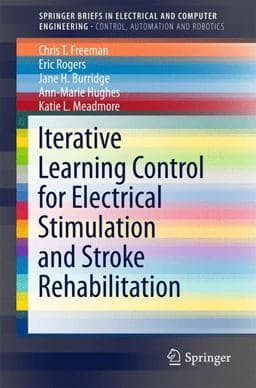
Iterative Learning Control for Electrical Stimulation and Stroke Rehabilitation
Format: Paperback
ISBN13: 9781447167259
Paperback|9781447167259
✨ Featured Offer
Brand New
$58.73
List Price: $54.99
🚚
See all 2 offers from $58.73 FREE standard delivery by: 04 Apr 2026
Overview
Iterative learning control (ILC) has its origins in the control of processes that perform a task repetitively with a view to improving accuracy from trial to trial by using information from previous executions of the task. This brief shows how a classic application of this technique - trajectory following in robots - can be extended to neurological rehabilitation after stroke.
Regaining upper limb movement is an important step in a return to independence after stroke, but the prognosis for such recovery has remained poor. Rehabilitation robotics provides the opportunity for repetitive task-oriented movement practice reflecting the importance of such intense practice demonstrated by conventional therapeutic research and motor learning theory. Until now this technique has not allowed feedback from one practice repetition to influence the next, also implicated as an important factor in therapy. The authors demonstrate how ILC can be used to adjust external functional electrical stimulation of patients' muscles while they are repeatedly performing a task in response to the known effects of stimulation in previous repetitions. As the motor nerves and muscles of the arm reaquire the ability to convert an intention to move into a motion of accurate trajectory, force and rapidity, initially intense external stimulation can now be scaled back progressively until the fullest possible independence of movement is achieved.
Regaining upper limb movement is an important step in a return to independence after stroke, but the prognosis for such recovery has remained poor. Rehabilitation robotics provides the opportunity for repetitive task-oriented movement practice reflecting the importance of such intense practice demonstrated by conventional therapeutic research and motor learning theory. Until now this technique has not allowed feedback from one practice repetition to influence the next, also implicated as an important factor in therapy. The authors demonstrate how ILC can be used to adjust external functional electrical stimulation of patients' muscles while they are repeatedly performing a task in response to the known effects of stimulation in previous repetitions. As the motor nerves and muscles of the arm reaquire the ability to convert an intention to move into a motion of accurate trajectory, force and rapidity, initially intense external stimulation can now be scaled back progressively until the fullest possible independence of movement is achieved.
| ISBN-13 | 9781447167259 |
|---|---|
| ISBN-10 | 1447167252 |
| Weight | 0.60 Pounds |
| Dimensions | 6.10 x 0.31 x 9.25 In |
| List Price | $54.99 |
| Edition | 1st Edition |
| Format | Paperback |
|---|---|
| Language | English |
| Pages | vii, 124 pages |
| Publisher | Springer |
| Published On | 2015-07-08 |
View All Offers
Sort by:
Price
Condition
Seller
Seller Comments
Price
✨ Brand New
Seller details
Alibris
Sparks, NV, USA
Print on demand Trade paperback (US). Glued binding. 124 p. Contains: Illustrations, black & white,...
Free delivery by: 04 Apr 2026
Brand New
Seller details
GreatBookPrices-
Columbia, MD, USA
100% Money Back Guarantee. Brand New, Perfect Condition. We offer expedited shipping to all US locat...
Free delivery by: 04 Apr 2026