
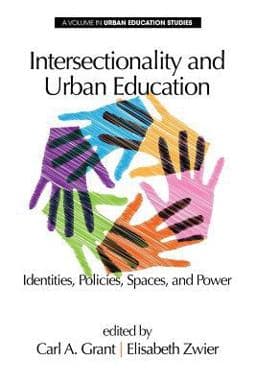
Intersectionality and Urban Education
Format: Paperback
ISBN13: 9781623967321
Paperback|9781623967321
✨ Featured Offer
Brand New
$60.37
List Price: $52.99
🚚
See all 5 offers from $41.93 FREE standard delivery by: 01 Apr 2026
Overview
A volume in Urban Education Studies Series Series Editors Nicholas D. Hartlep, Illinois State University, Thandeka K. Chapman, University of California, San Diego and Kenny Varner, Louisiana State University In urban education, "urban" is a floating signifier that is imbued with meaning, positive or negative by its users. "Urban" can be used to refer to both the geographical context of a city and a sense of "less than," most often in relation to race and/ or socioeconomic status (Watson, 2011). For Noblit and Pink (2007), "Urban, rather, is a generalization as much about geography as it is about the idea that urban centers have problems: problems of too many people, too much poverty, too much crime and violence, and ultimately, too little hope" (p. xv). Recently, urban education scholars such as Anyon (2005), Pink and Noblit (2007), Blanchett, Klinger and Harry (2009), and Lipman (2013) have elucidated the social construction of oppression and privilege for urban students, teachers, schools, families, and communities using intersectionality theories. Building on their work, we see the need for an edited collection that would look across the different realms of urban education-theorizing identity markers in urban education, education in urban schools and communities, thinking intersectionally in teacher education & higher education, educational policies & urban spaces-seeking to better understand each topic using an intersectional lens. Such a collection might serve to conceptually frame or provide methodological tools, or act as a reference point for scholars and educators who are trying to address urban educational issues in light of identities and power. Secondly, we argue that education questions and/or problems beg to be conceptualized and analyzed through more than one identity axis. Policies and practices that do not take into account urban students' intertwining identity markers risk reproducing patterns of privilege and oppression, perpetuating stereotypes, and failing at the task we care most deeply about: supporting all students' learning across a holistic range of academic, personal, and justice-oriented outcomes. Can educational policies and practices address the social justice issues faced in urban schools and communities today? We argue that doing intersectional research and implementing educational policies and practices guided by these frameworks can help improve the "fit." Particular attention needs to be paid to intersectionality as a lens for educational theory, policy, and practice. As urban educators we would be wise to consider the intertwining of these identity axes in order to better analyze educational issues and engage in teaching, learning, research, and policymaking that are better-tuned to the needs of diverse students, families, and communities.
| ISBN-13 | 9781623967321 |
|---|---|
| ISBN-10 | 1623967325 |
| Weight | 1.03 Pounds |
| Dimensions | 6.13 x 0.75 x 9.25 In |
| List Price | $52.99 |
| Format | Paperback |
|---|---|
| Language | English |
| Pages | 332 pages |
| Publisher | Information Age Publishing |
| Published On | 2014-09-01 |
View All Offers
Sort by:
Price
Condition
Seller
Seller Comments
Price
Used, Very Good
Seller details
Half Price Books Inc
Dallas, TX, USA
Connecting readers with great books since 1972! Used books may not include companion materials, and ...
Free delivery by: 01 Apr 2026
✨ Brand New
Seller details
Alibris
Sparks, NV, USA
Print on demand Urban Education Studies Series . Intended for professional and scholarly audience.
Free delivery by: 01 Apr 2026
Brand New
Seller details
GreatBookPrices-
Columbia, MD, USA
100% Money Back Guarantee. Brand New, Perfect Condition. We offer expedited shipping to all US locat...
Free delivery by: 01 Apr 2026
Used, Good
Seller details
Bonita
Santa Clarita, CA, USA
Access codes and supplements are not guaranteed with used items. May be an ex-library book.
Free delivery by: 01 Apr 2026
Brand New
Seller details
Bonita
Santa Clarita, CA, USA
Free delivery by: 01 Apr 2026