
✨ Featured Offer
Overview
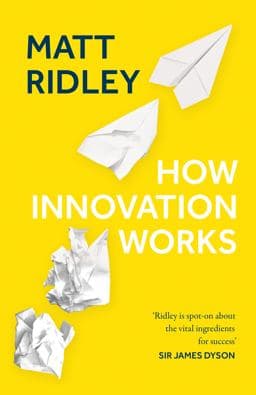
'Ridley is spot-on when it comes to the vital ingredients for success' Sir James Dyson
Building on his bestseller The Rational Optimist, Matt Ridley chronicles the history of innovation, and how we need to change our thinking on the subject.
Innovation is the main event of the modern age, the reason we experience both dramatic improvements in our living standards and unsettling changes in our society. It is innovation that will shape the twenty-first century. Yet innovation remains a mysterious process, poorly understood by policy makers and businessmen alike.
Matt Ridley argues that we need to see innovation as an incremental, bottom-up, fortuitous process that happens as a direct result of the human habit of exchange, rather than an orderly, top-down process developing according to a plan. Innovation is crucially different from invention, because it is the turning of inventions into things of practical and affordable use to people. It speeds up in some sectors and slows down in others. It is always a collective, collaborative phenomenon, involving trial and error, not a matter of lonely genius. It still cannot be modelled properly by economists, but it can easily be discouraged by politicians. Far from there being too much innovation, we may be on the brink of an innovation famine.
Ridley derives these and other lessons from the lively stories of scores of innovations - from steam engines to search engines - how they started and why they succeeded or failed.
Building on his bestseller The Rational Optimist, Matt Ridley chronicles the history of innovation, and how we need to change our thinking on the subject.
Innovation is the main event of the modern age, the reason we experience both dramatic improvements in our living standards and unsettling changes in our society. It is innovation that will shape the twenty-first century. Yet innovation remains a mysterious process, poorly understood by policy makers and businessmen alike.
Matt Ridley argues that we need to see innovation as an incremental, bottom-up, fortuitous process that happens as a direct result of the human habit of exchange, rather than an orderly, top-down process developing according to a plan. Innovation is crucially different from invention, because it is the turning of inventions into things of practical and affordable use to people. It speeds up in some sectors and slows down in others. It is always a collective, collaborative phenomenon, involving trial and error, not a matter of lonely genius. It still cannot be modelled properly by economists, but it can easily be discouraged by politicians. Far from there being too much innovation, we may be on the brink of an innovation famine.
Ridley derives these and other lessons from the lively stories of scores of innovations - from steam engines to search engines - how they started and why they succeeded or failed.
| ISBN-13 | 9780008339074 |
|---|---|
| ISBN-10 | 0008339074 |
| Weight | 1.15 Pounds |
| Dimensions | 6.02 x 1.26 x 9.21 In |
| Format | Paperback |
|---|---|
| Language | English |
| Pages | 416 pages |
| Publisher | 4th Estate GB |
| Published On | 2020-01-01 |
View All Offers
Sort by:
Price
Condition
Seller
Seller Comments
Price
Used, Very Good
Seller details
HPB-Diamond
Dallas, TX, USA
Connecting readers with great books since 1972! Used books may not include companion materials, and ...
Free delivery by: 04 Apr 2026
Used, Good
Seller details
Orion Tech
Arlington, TX, USA
Size: 6x1x9;
Free delivery by: 04 Apr 2026
✨ Brand New
Seller details
Your Online Bookstore
Houston, TX, USA
Size: 6x1x9;
Free delivery by: 04 Apr 2026
Brand New
Seller details
McConnell Content Creation
Dayton, OH, USA
Free delivery by: 04 Apr 2026
Brand New
Seller details
McConnell Content Creation
Dayton, OH, USA
Free delivery by: 04 Apr 2026