
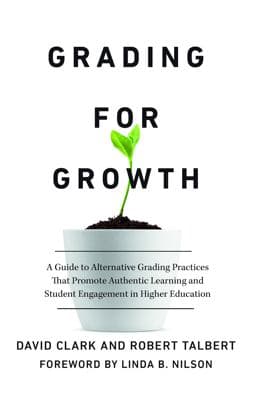
Grading for Growth
Format: Paperback
ISBN13: 9781642673814
✨ Featured Offer
Brand New
$43.92
List Price: $36.95
FREE standard delivery by: 30 Mar 2026
Overview
Are you satisfied with your current and traditional grading system? Does it accurately reflect your students' learning and progress? Can it be gamed? Does it lead to grade-grubbing and friction with your students?
The authors of this book - two professors of mathematics with input from colleagues across disciplines and institutions - offer readers a fundamentally more effective and authentic approach to grading that they have implemented for over a decade. Recognizing that traditional grading penalizes students in the learning process by depriving them of the formative feedback that is fundamental to improvement, the authors offer alternative strategies that encourage revision and growth.
Alternative grading is concerned with students' eventuallevel of understanding. This leads to big changes: Students take time to review past failures and learn from them. Conversations shift from "why did I lose a point for this" to productive discussions of content and process.
Alternative grading can be used successfully at anylevel, in anysituation, and anydiscipline, in classes that range from seminars to large multi-section lectures.
This book offers a comprehensive introduction to alternative grading, beginning with a framework and rationale for implementation and evidence of its effectiveness. The heart of the book includes detailed examples - including variations on Standards-Based Grading, Specifications Grading, and ungrading -- of how alternative grading practices are used in all kinds of classroom environments, disciplines and institutions with a focus on first-hand accounts by faculty who share their practices and experience. The book includes a workbook chapter that takes readers through a step-by-step process for building a prototype of their own alternatively graded class and ends with concrete, practical, time-tested advice for new practitioners.
The underlying principles of alternative grading involve
- Evaluating student work using clearly defined and context-appropriate content standards.
- Giving students helpful, actionable feedback.
- Summarizing the feedback with marks that indicate progress rather than arbitrary numbers.
- Allowing students to revise without penalty, using the feedback they receive, until the standards are met or exceeded.
This book is intended for faculty interested in exploring alternative forms of learning assessment as well as those currently using alternative grading systems who are looking for ideas and options to refine practice.
| ISBN-13 | 9781642673814 |
|---|---|
| ISBN-10 | 1642673811 |
| Weight | 0.80 Pounds |
| Dimensions | 5.98 x 0.59 x 9.02 In |
| List Price | $36.95 |
| Edition | 1st Edition |
| Format | Paperback |
|---|---|
| Language | English |
| Pages | 252 pages |
| Publisher | Routledge |
| Published On | 1900-01-01 |
View All Offers
Sort by:
Seller details
Brooklyn Park, MN, USA
Free delivery by: 30 Mar 2026
Seller details
Simi Valley, CA, USA
Free delivery by: 30 Mar 2026
Seller details
Medford, NY, USA
Free delivery by: 30 Mar 2026
Seller details
Columbia, MD, USA
Free delivery by: 30 Mar 2026
Seller details
Columbia, MD, USA
Free delivery by: 30 Mar 2026