
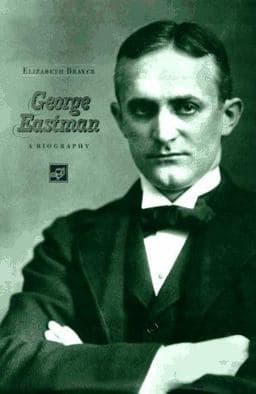
George Eastman
Format: Hardcover
ISBN13: 9780801852633
Hardcover|9780801852633
✨ Featured Offer
Used, Very Good
$23.39
List Price: $53.00
🚚
See all 5 offers from $6.94 FREE standard delivery by: 02 Apr 2026
Overview
This life of George Eastman is the first biography since 1930 of the man who transformed the world of photography. As a 23-year-old bank clerk, Eastman bought his first camera and began simplifying the cumbersome and messy wet-plate process. With only two years' experience, he patented a dry-plate coating machine and began selling photographic plates. Soon, the business was doing so well that he quit his job at the bank and started his own company. Eastman's success was based in part on his own inventions, but even more on his ability to raise capital, recruit technically skilled employees, sell his own products, and outmaneuver his competitors. In this revealing and informative new biography, Brayer shows us how such key innovations as roll film and the light, hand-held camera helped the Eastman Kodak Company dominate the world market. More importantly, Brayer draws a vivid portrait of the man behind the money. Eastman worked hard at keeping out of the limelight and even insisted that his donations be kept anonymous, prompting the Boston Globe to call him "America's most modest and least- known millionaire." His aggressive business personality was a sharp contrast to his personal life: Eastman once joked that it was his goal to take two six-month vacations in a year. He would regularly forsake the office to bicycle around Europe or ride a stagecoach through the snowy trails of Yellowstone Park. He was an art lover, who once bartered 60 shares of Kodak stock in the 1890s for a painting he felt he must have, and a classical music enthusiast, who built a school for the training of virtuosos. Despite his retirement in 1925, Eastman showed little sign of slowing down. Making money had been interesting, but putting money to work became more so. In the 1920s he designed a special camera for use in orthodontia and established elaborate dental clinics for needy children in Rochester, London, Paris, Brussels, Stockholm, and Rome. He oversaw the building of the Eastman Theatre and the Eastman School of Music. His contributions built a new campus for the Massachusetts Institute of Technology and a new medical school for the University of Rochester. Finally, he became the largest contributor to the education of African Americans during the 1920s and the Tuskeegee Institute's most important benefactor.
| ISBN-13 | 9780801852633 |
|---|---|
| ISBN-10 | 0801852633 |
| Weight | 0.00 Pounds |
| Dimensions | 7.00 x 2.25 x 9.75 In |
| List Price | $53.00 |
| Edition | 1st Edition |
| Format | Hardcover |
|---|---|
| Pages | 648 pages |
| Publisher | The Johns Hopkins University Press |
| Published On | 1981-01-01 |
View All Offers
Sort by:
Price
Condition
Seller
Seller Comments
Price
Used, Good
Seller details
Greenworld Books
Arlington, TX, USA
Good condition. It may show normal signs of use such as light writing highlighting or library markin...
Free delivery by: 02 Apr 2026
Used, Good
Seller details
Books From California
Simi Valley, CA, USA
Ex-library copy with the usual markings/stickers/stamping present, including stamping on the page ...
Free delivery by: 02 Apr 2026
✨ Used, Very Good
Seller details
Jonathan Grobe Books
Deep River, IA, USA
0801852633. Exlibrary with usual library markings.; 637 pages.
Free delivery by: 02 Apr 2026
Used, Very Good
Seller details
Grendel Books, ABAA/ILAB
Springfield, MA, USA
0801852633. First printing. Near fine in a fine dust jacket.
Free delivery by: 02 Apr 2026
Used, Very Good
Seller details
Grendel Books, ABAA/ILAB
Springfield, MA, USA
0801852633. First printing thus. About fine in like dust jacket.
Free delivery by: 02 Apr 2026