
Folding Techniques for Designers
by Paul Jackson
Format: Paperback
ISBN13: 9781856697217
Paperback|9781856697217
✨ Featured Offer
Brand New
$176.60
List Price: $35.00
🚚
See all 5 offers from $14.71 FREE standard delivery by: 31 Mar 2026
Overview
"This highly practical release covers more than 70 different techniques, and teaches designers how to make such works through step-by-step examples and a CD containing pre-designed folding patterns" - Computer Arts
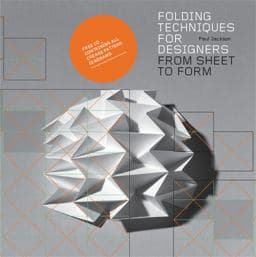
Folding Techniques for Designers is a practical handbook, written by an expert in paper folding and origami, with specially commissioned step-by-step drawings and photographs clearly explaining over 70 folding techniques.
Many, if not most designers use folding techniques in their work to make 3D forms from 2D sheets of fabric, cardboard, plastic, metal and many other materials. This unique book explains the key techniques of folding, such as pleated surfaces, curved folding and crumpling. It has applications for architects, product designers, and jewelry and fashion designers.
Folding Techniques for Designers explains over 70 different folds, explained with clear step-by-step drawings, crease pattern drawings, and specially commissioned photography.
All crease pattern drawings are available to view and download at laurenceking.com
Author Paul Jackson has released more than 30 books on paper arts and crafts. He has taught the techniques of folding on more than 150 university-level design courses in the UK, Germany, Belgium, the US, Canada and Israel. These include courses of Architecture, Graphic Design, Fashion Design, Textile Design, Jewelry, Product Design, Packaging, Ceramics, Industrial Design, Fine Art, Basic Design and Interior Design.
From the introduction:
"All designers fold.
That is, all designers crease, pleat, bend, hem, gather, knot, hinge, corrugate, drape, twist, furl, crumple, collapse, wrinkle, facet, curve or wrap two-dimensional sheets of material, and by these processes of folding, create three-dimensional objects. These objects will perhaps not be origami-like in appearance, or the folding may only be a detail, but most will nevertheless have been folded - wholly or in part - in some way. Since almost all objects are made from sheet materials (such as fabric, plastic, sheet metal or cardboard), or are fabricated from components used to make sheet forms (such as bricks - a brick wall is a sheet form), folding can be considered one of the most common of all design techniques.
And yet, despite being so ubiquitous, folding as a design topic is rarely studied. Perhaps this is because the folded content in a designed object is often unrecognized, or merely incidental, or because folding is synonymous with origami, with brightly colored squares and children's hobbycrafts (an image of origami now several decades out of date). Folding is rarely an inspiration for designers.
At least, that is how it used to be. In recent years, more and more designers of all disciplines have turned to folding to create a wide range of handmade and manufactured objects, both functional and decorative. A little time spent looking through design and style magazines will reveal a significant number of folded products, from apparel to lighting and from architecture to jewelry. Origami is one of the most vibrant buzzwords in contemporary design." -- Paul Jackson
Folding Techniques for Designers is a practical handbook, written by an expert in paper folding and origami, with specially commissioned step-by-step drawings and photographs clearly explaining over 70 folding techniques.
Many, if not most designers use folding techniques in their work to make 3D forms from 2D sheets of fabric, cardboard, plastic, metal and many other materials. This unique book explains the key techniques of folding, such as pleated surfaces, curved folding and crumpling. It has applications for architects, product designers, and jewelry and fashion designers.
Folding Techniques for Designers explains over 70 different folds, explained with clear step-by-step drawings, crease pattern drawings, and specially commissioned photography.
All crease pattern drawings are available to view and download at laurenceking.com
Author Paul Jackson has released more than 30 books on paper arts and crafts. He has taught the techniques of folding on more than 150 university-level design courses in the UK, Germany, Belgium, the US, Canada and Israel. These include courses of Architecture, Graphic Design, Fashion Design, Textile Design, Jewelry, Product Design, Packaging, Ceramics, Industrial Design, Fine Art, Basic Design and Interior Design.
From the introduction:
"All designers fold.
That is, all designers crease, pleat, bend, hem, gather, knot, hinge, corrugate, drape, twist, furl, crumple, collapse, wrinkle, facet, curve or wrap two-dimensional sheets of material, and by these processes of folding, create three-dimensional objects. These objects will perhaps not be origami-like in appearance, or the folding may only be a detail, but most will nevertheless have been folded - wholly or in part - in some way. Since almost all objects are made from sheet materials (such as fabric, plastic, sheet metal or cardboard), or are fabricated from components used to make sheet forms (such as bricks - a brick wall is a sheet form), folding can be considered one of the most common of all design techniques.
And yet, despite being so ubiquitous, folding as a design topic is rarely studied. Perhaps this is because the folded content in a designed object is often unrecognized, or merely incidental, or because folding is synonymous with origami, with brightly colored squares and children's hobbycrafts (an image of origami now several decades out of date). Folding is rarely an inspiration for designers.
At least, that is how it used to be. In recent years, more and more designers of all disciplines have turned to folding to create a wide range of handmade and manufactured objects, both functional and decorative. A little time spent looking through design and style magazines will reveal a significant number of folded products, from apparel to lighting and from architecture to jewelry. Origami is one of the most vibrant buzzwords in contemporary design." -- Paul Jackson
| ISBN-13 | 9781856697217 |
|---|---|
| ISBN-10 | 1856697215 |
| Weight | 1.57 Pounds |
| Dimensions | 8.75 x 1.00 x 8.76 In |
| List Price | $35.00 |
| Edition | 10th Edition |
| Format | Paperback |
|---|---|
| Language | English |
| Pages | 224 pages |
| Publisher | Laurence King Publishing |
| Published On | 2011-05-11 |
View All Offers
Sort by:
Price
Condition
Seller
Seller Comments
Price
Used, Good
Seller details
Evergreen Goodwill
Seattle, WA, USA
Free delivery by: 31 Mar 2026
Used, Very Good
Seller details
HPB-Diamond
Dallas, TX, USA
Connecting readers with great books since 1972! Used books may not include companion materials, and ...
Free delivery by: 31 Mar 2026
Used, Very Good
Seller details
HPB-Diamond
Dallas, TX, USA
Connecting readers with great books since 1972! Used books may not include companion materials, and ...
Free delivery by: 31 Mar 2026
Used, Good
Seller details
Bonita
Santa Clarita, CA, USA
Access codes and supplements are not guaranteed with used items. May be an ex-library book.
Free delivery by: 31 Mar 2026
✨ Brand New
Seller details
Bonita
Santa Clarita, CA, USA
Free delivery by: 31 Mar 2026