
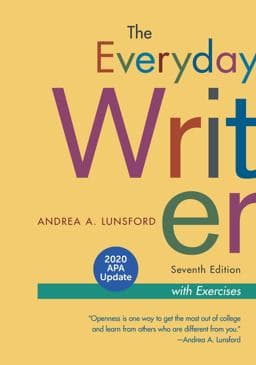
The Everyday Writer with Exercises, 2020 APA Update
Format: Spiral-bound
ISBN13: 9781319361136
✨ Featured Offer
Used, Very Good
$17.08
List Price: $105.45
FREE standard delivery by: 04 Apr 2026
Overview
Writing Rhetorically
1 Expectations for College Writing: Open your book, open your mind
a Choose openness
b Use social media wisely
c Position yourself as an academic writer
d Read and listen respectfully, actively, and critically
e Plan research
f Use digital tools effectively
2 Rhetorical Situations
a Make good choices for your rhetorical situation
b Plan your text''s topic and message
c Consider your purpose and stance as a communicator
d Analyze your audience
e Think about genres and media
f Consider language and style
g A SAMPLE RHETORICAL SITUATION
3 Exploring, Planning, and Drafting
a Explore your topic
b Narrow your topic
c Craft a working thesis
d Gather information
e Organize information
f Make a plan
g Create a draft
4 Developing Paragraphs
a Focus on a main idea
b Provide details
c Use effective methods of development
d Make paragraphs flow
e Work on opening and closing paragraphs
5 Reviewing, Revising, and Editing
a Review your writing
b Get the most from peer review
c Consult instructor comments
d Revise
e Edit
6 Reflecting
a Reflect to present your work effectively
A STUDENT''s REFLECTIVE STATEMENT
b Reflect to learn
A STUDENT''s REFLECTIVE BLOG POST
Critical Thinking and Argument
7 Critical Reading
a Consider reading collaboratively
b Preview the text; consider the source
c Read and annotate the text
d Summarize the main ideas
e Analyze and reflect on the text
f Think critically about visual texts
g A STUDENT''S CRITICAL READING
8 Analyzing Arguments
a Think critically about argument
b Recognize cultural contexts
c Identify an arguments''s basic appeals
d Recognize the use of stories in argument
e Understand Toulmin''s elements of argument
f Think critically about fallacies
g A STUDENT''S RHETORICAL ANALYSIS
9 Constructing arguments
a Understand purposes for argument
b Determine whether a statement can be argued
c Make a claim and draft a working thesis
d Examine your assumptions
e Shape your appeal to your audience
f Consider the use of narratives or stories
g Establish credibility through ethical appeals
h Use effective logical appeals
i Use appropriate emotional appeals
j Consult sources
k Organize your argument
l Consider design and delivery
m A STUDENT''S ARGUMENT ESSAY
Research
10 Doing research
a Preparefor a research project
b Form a research question and hypothesis
c Plan your research
d Move from hypothesis to working thesis
e Understand different kinds of sources
f Use web and library resources
g Consulting your library''s staff, databases, and other resources
h Conduct field research
11 Evaluating Sources
a Understand why writers use sources
b Create a working bibliography or an annotated bibliography
c Evaluate a source''s usefulness and credibility
d Read critically, and interpret sources
e Synthesize sources
12 Integrating Sources and Avoiding Plagiarism
a Decide whether to quote, paraphrase, or summarize
b Integrate quotations, paraphrases, and summaries effectively
c Integrate visuals and media effectively and ethically
d Understand why acknowledging sources matters
e Know which sources to acknowledge
f Recognize patch writing
g Uphold your academic integrity, and avoid plagiarism
h Write and revise a research project
Academic, Professional, and Public Writing
13 Writing Well in Any Discipline or Profession
a Consider genres across disciplines and professions
b Consider expectations for academic assignments
c Learn specialized vocabularies and styles
d Use evidence effectively
e Pay attention to ethical issues
f Collaborate effectively and with an open mind
14 Writing for the Humanities
a Read texts in the humanities
b Write texts in the humanities
c A STUDENT''S CLOSE READING OF POETRY
15 Writing for the Social Sciences
a Read texts in the social sciences
b Write texts in the social sciences
c EXCERPT FROM A STUDENT''S PSYCHOLOGY LITERATURE REVIEW
16 Writing for the Natural and Applied Sciences
a Read texts in the natural and applied sciences
b Write texts in the natural and applied sciences
c EXCERPT FROM A STUDENT''S CHEMISTRY LAB REPORT
17 Writing in Professional Settings
a Read texts for business
b Write texts for business
STUDENT MEMO
TRADITIONAL RÉSUMÉ
CREATIVE RÉSUMÉ
18 Making Design Decisions
a Choose a type of text
b Plan a visual structure
c Format print and digital texts appropriately
d Consider visuals and media
19 Creating Presentations
a Consider assignment, purpose, and audience for presentations
b Write to be heard and remembered
c Create slides or other visuals
d Practice and deliver the presentation
e Consider other kinds of presentations
20 Communicating in Other Media
a Consider your rhetorical context
b Consider types of multimodal texts
c Plan features of texts
21 Writing to Make Something Happen in the World
a Decide what should happen
b Connect with your audience
c SAMPLE WRITING TO MAKE SOMETHING HAPPEN IN THE WORLD
Language and Style
22 Language and Identity
a Recognize how the language of others can shape identity
b Use language to shape your own identity
23 Language Varieties
a Use "standard" varieties of English appropriately
b Use varieties of English to evoke a place or community
c Build credibility within a community with language variety
d Bring in other languages appropriately
24 Writing to the World
a Think about what seems "normal"
b Clarify meaning
c Meet audience expectations
25 Language That Builds Common Ground
a Examine assumptions and avoid stereotypes
b Examine assumptions about gender
c Examine assumptions about race and ethnicity
d Consider other kinds of difference
26 Style Matters
a Use effective words and figures of speech
b Use powerful verbs
c Use varied sentence lengths and openings
27 Coordination, Subordination, and Emphasis
a Use coordination to relate equal ideas
b Use subordination to distinguish main ideas
c Use closing and opening positions for emphasis
28 Consistency and Completeness
a Revise faulty sentence structure
b Match up subjects and predicates
c Use elliptical structures carefully
d Check for missing words
e Make comparisons complete, consistent, and clear
29 Parallelism
a Make items in a series parallel
b Make paired ideas parallel
c Include all necessary words
30 Shifts
a Revise unnecessary shifts in verb tense
b Revise unnecessary shifts in mood
c Revise unnecessary shifts in voice
d Revise unnecessary shifts in person and number
e Revise shifts between direct and indirect discourse
f Revise shifts in tone and word choice
31 Conciseness
a Eliminate unnecessary words
b Simplify sentence structure
The Top Twenty
32 The Top Twenty: A Quick Guide to Editing Your Writing
Wrong word
Missing comma after an introductory element
Incomplete or missing documentation
Vague pronoun reference
Spelling (including homonyms)
Mechanical error with a quotation
Unnecessary comma
Unnecessary or missing capitalization
Missing word
Faulty sentence structure
Missing comma with nonrestrictive element
Unnecessary shift in verb tense
Missing comma in a compound sentence
Unnecessary or missing apostrophe (including its/it''s)
Fused (run-on) sentence
Comma splice
Lack of pronoun-antecedent agreement
Poorly integrated quotation
Unnecessary or missing hyphen
Sentence fragment
Sentence Grammar
33 Parts of
| ISBN-13 | 9781319361136 |
|---|---|
| ISBN-10 | 1319361137 |
| Weight | 1.57 Pounds |
| Dimensions | 6.41 x 1.05 x 8.52 In |
| List Price | $105.45 |
| Edition | 7th Edition |
| Format | Spiral-bound |
|---|---|
| Language | English |
| Pages | 656 pages |
| Publisher | Bedford/St. Martin's |
| Published On | 2020-06-29 |
View All Offers
Sort by:
Seller details
Conway, AR, USA
Free delivery by: 04 Apr 2026
Seller details
Dallas, TX, USA
Free delivery by: 04 Apr 2026
Seller details
Roanoke, VA, USA
Free delivery by: 04 Apr 2026
Seller details
Columbia, MO, USA
Free delivery by: 04 Apr 2026
Seller details
Little Rock, AR, USA
Free delivery by: 04 Apr 2026