
✨ Featured Offer
Used, Like New
$8.09
List Price: $29.95
🚚
See all 5 offers from $6.91 FREE standard delivery by: 31 Mar 2026
Overview
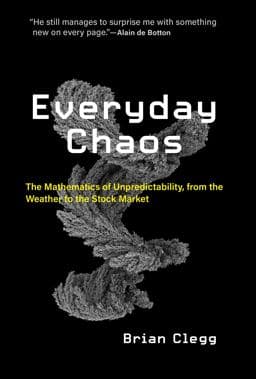
Chaos and complexity explained, with illuminating examples ranging from unpredictable pendulums to London's wobbly Millennium Bridge.The math we are taught in school is precise and only deals with simple situations. Reality is far more complex. Trying to understand a system with multiple interacting components-the weather, for example, or the human body, or the stock market-means dealing with two factors- chaos and complexity. If we don't understand these two essential subjects, we can't understand the real world. In Everyday Chaos, Brian Clegg explains chaos and complexity for the general reader, with an accessible, engaging text and striking full-color illustrations.
By chaos, Clegg means a system where complex interactions make predicting long-term outcomes nearly impossible; complexity means complex interacting systems that have new emergent properties that make them more than the sum of their parts. Clegg illustrates these phenomena with discussions of predictable randomness, the power of probability, and the behavior of pendulums. He describes what Newton got wrong about gravity; how feedback kept steam engines from exploding; and why weather produces chaos. He considers the stock market, politics, bestseller lists, big data, and London's wobbling Millennium Bridge as examples of chaotic systems, and he explains how a better understanding of chaos helps scientists predict more accurately the risk of catastrophic Earth-asteroid collisions. We learn that our brains are complex, self-organizing systems; that the structure of snowflakes exemplifies emergence; and that life itself has been shown to be an emergent property of a complex system.
By chaos, Clegg means a system where complex interactions make predicting long-term outcomes nearly impossible; complexity means complex interacting systems that have new emergent properties that make them more than the sum of their parts. Clegg illustrates these phenomena with discussions of predictable randomness, the power of probability, and the behavior of pendulums. He describes what Newton got wrong about gravity; how feedback kept steam engines from exploding; and why weather produces chaos. He considers the stock market, politics, bestseller lists, big data, and London's wobbling Millennium Bridge as examples of chaotic systems, and he explains how a better understanding of chaos helps scientists predict more accurately the risk of catastrophic Earth-asteroid collisions. We learn that our brains are complex, self-organizing systems; that the structure of snowflakes exemplifies emergence; and that life itself has been shown to be an emergent property of a complex system.
| ISBN-13 | 9780262539692 |
|---|---|
| ISBN-10 | 0262539691 |
| Weight | 1.36 Pounds |
| Dimensions | 6.38 x 0.82 x 9.50 In |
| List Price | $29.95 |
| Format | Paperback |
|---|---|
| Pages | 256 pages |
| Publisher | The MIT Press |
| Published On | 2020-10-06 |
View All Offers
Sort by:
Price
Condition
Seller
Seller Comments
Price
Used, Good
Seller details
Dream Books Co.
Denver, CO, USA
Gently used with minimal wear on the corners and cover. A few pages may contain light highlighting...
Free delivery by: 31 Mar 2026
Used, Very Good
Seller details
The Maryland Book Bank
baltimore, MD, USA
Used-Very Good.
Free delivery by: 31 Mar 2026
✨ Used, Like New
Seller details
spellbound
McKeesport, PA, USA
LIKE NEW! ! ! Has a red or black remainder mark on bottom/exterior edge of pages.
Free delivery by: 31 Mar 2026
Used, Like New
Seller details
Big River Books
Powder Springs, GA, USA
This book is in Like New condition. It is unused but has a remainder mark on the edge of the pages. ...
Free delivery by: 31 Mar 2026
Used, Very Good
Seller details
Book Dispensary
Niagara Falls, NY, USA
Book VERY GOOD softcover, no marks in text; a very clean, gently used copy.
Free delivery by: 31 Mar 2026