
✨ Featured Offer
Used, Very Good
$8.69
List Price: $17.99
🚚
See all 5 offers from $5.93 FREE standard delivery by: 31 Mar 2026
Overview
When it comes to science, too often people say "I just don't have the brains for it" -- and leave it at that. Why is science so intimidating, and why do people let themselves feel this way? What makes one person a scientist and another disinclined even to learn how to read graphs? The idea that scientists are people who wear lab coats and are somehow smarter than the rest of us is a common, yet dangerous, misconception that puts science on an intimidating pedestal. How did science become so divorced from everyday experience?
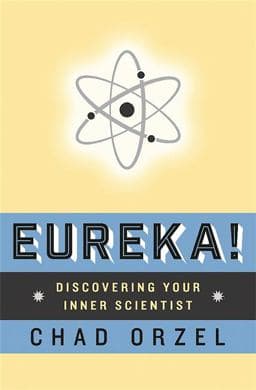
In Eureka, science popularizer Chad Orzel argues that even the people who are most forthright about hating science are doing science, often without even knowing it. Orzel shows that science is central to the human experience: every human can think like a scientist, and regularly does so in the course of everyday activities. The common misconception is that science is a body of (boring, abstract, often mathematical) facts. In truth, science is a process: Looking at the world, Thinking about what makes it work, Testing your mental model by comparing it to reality, and Telling others about your results -- all things that people do daily. By revealing the connection between the everyday activities that people do -- solving crossword puzzles, playing sports, or even watching mystery shows on television -- and the processes used to make great scientific discoveries, Eureka shows that this process is one everybody uses regularly, and something that anyone can do.
In Eureka, science popularizer Chad Orzel argues that even the people who are most forthright about hating science are doing science, often without even knowing it. Orzel shows that science is central to the human experience: every human can think like a scientist, and regularly does so in the course of everyday activities. The common misconception is that science is a body of (boring, abstract, often mathematical) facts. In truth, science is a process: Looking at the world, Thinking about what makes it work, Testing your mental model by comparing it to reality, and Telling others about your results -- all things that people do daily. By revealing the connection between the everyday activities that people do -- solving crossword puzzles, playing sports, or even watching mystery shows on television -- and the processes used to make great scientific discoveries, Eureka shows that this process is one everybody uses regularly, and something that anyone can do.
| ISBN-13 | 9780465074969 |
|---|---|
| ISBN-10 | 0465074960 |
| Weight | 0.84 Pounds |
| Dimensions | 5.50 x 1.00 x 8.25 In |
| List Price | $17.99 |
| Edition | 1st Edition |
| Format | Paperback |
|---|---|
| Language | English |
| Pages | 368 pages |
| Publisher | Basic Books |
| Published On | 2014-12-09 |
View All Offers
Sort by:
Price
Condition
Seller
Seller Comments
Price
Used, Good
Seller details
Goodwill of Greater Milwaukee
Milwaukee, WI, USA
Book is considered to be in good or better condition. The actual cover image may not match the sto...
Free delivery by: 31 Mar 2026
✨ Used, Very Good
Seller details
Half Price Books Inc
Dallas, TX, USA
Connecting readers with great books since 1972! Used books may not include companion materials, and ...
Free delivery by: 31 Mar 2026
Used, Very Good
Seller details
Half Price Books Inc
Dallas, TX, USA
Connecting readers with great books since 1972! Used books may not include companion materials, and ...
Free delivery by: 31 Mar 2026
Used, Very Good
Seller details
Bookoutlet
Bridgeton, NJ, USA
Great shape! Has a publisher remainder mark. paperback Used-Very Good 2014.
Free delivery by: 31 Mar 2026
Used, Very Good
Seller details
Reliant Bookstore
El Dorado, KS, USA
This book is in excellent condition. There may be minimal writing on the inside cover or cover page....
Free delivery by: 31 Mar 2026