
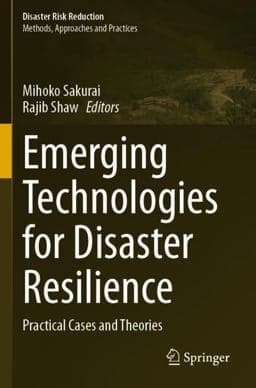
Emerging Technologies for Disaster Resilience
Format: Paperback
ISBN13: 9789811603624
✨ Featured Offer
Brand New
$172.16
List Price: $159.99
FREE standard delivery by: 03 Apr 2026
Overview
Technological advances have helped to enhance disaster resilience through better risk reduction, response, mitigation, rehabilitation and reconstruction. In former times, it was local and traditional knowledge that was mainly relied upon for disaster risk reduction. Much of this local knowledge is still valid in today's world, even though possibly in different forms and contexts, and local knowledge remains a shared part of life within the communities. In contrast, with the advent of science and technology, scientists and engineers have become owners of advanced technologies, which have contributed significantly to reducing disaster risks across the globe.
This book analyses emerging technologies and their effects in enhancing disaster resilience. It also evaluates the gaps, challenges, capacities required and the way forward for future disaster management. A wide variety of technologies are addressed, focusing specifically on new technologies such as cyber physical systems, geotechnology, drone, and virtual reality (VR)/ augmented reality (AR). Other sets of emerging advanced technologies including an early warning system and a decision support system are also reported on. Moreover, the book provides a variety of discussions regarding information management, communication, and community resilience at the time of a disaster. This book's coverage of different aspects of new technologies makes it a valuable resource for students, researchers, academics, policymakers, and development practitioners.| ISBN-13 | 9789811603624 |
|---|---|
| ISBN-10 | 9811603626 |
| Weight | 0.94 Pounds |
| Dimensions | 6.10 x 0.63 x 9.25 In |
| List Price | $159.99 |
| Edition | 1st Edition |
| Format | Paperback |
|---|---|
| Language | English |
| Pages | xiii, 260 pages |
| Publisher | Springer |
| Published On | 2022-05-08 |
View All Offers
Sort by:
Seller details
Sparks, NV, USA
Free delivery by: 03 Apr 2026