
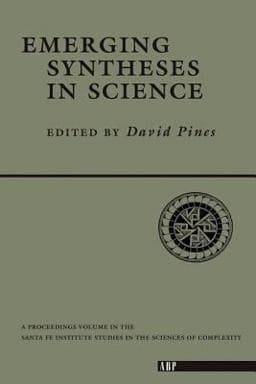
Emerging Syntheses in Science
by David Pines
Format: Paperback
ISBN13: 9780201156867
Paperback|9780201156867
✨ Featured Offer
Brand New
$52.80
List Price: $42.95
🚚
See all 4 offers from $40.87 FREE standard delivery by: 31 Mar 2026
Overview
Evolution of self-replicating macromolecules through natural selection is a dynamically ordered process. Two concepts are introduced to describe the physical regularity of macromolecular evolution: sequence space and quasi-species. Natural selection means localization of a mutant distribution in sequence space. This localized distribution, called the quasi-species, is centered around a master sequence (or a degenerate set), that the biologist would call the wild-type. The self-ordering of such a system is an essential consequence of its formation through self-reproduction of its macromolecular consti tuents, a process that in the dynamical equations expresses itself by positive diagonal coefficients called selective values. The theory describes how population numbers of wild type and mutants are related to the distribution of selective values, that is to say, how value topography maps into population topography. For selectively (nearly) neutral mutants appearing in the quasi- species distribution, population numbers are greatly enhanced as compared to those of disadvantageous mutants, even more so in continuous domains of such selectively valuable mutants. As a consequence, mutants far distant from the wild type may occur because they are produced with the help of highly populated, less distant precursors. Since values are cohesively distributed, like mountains on earth, and since their positions are multiply connected in the high-dimensional sequence space, the overpopulation of (nearly) neural mutants provides guidance for the evolutionary process. Localization in sequence space, subject to a threshold in the fidelity of reproduction, is steadily challenged until an optimal state is reached. The model has been designed according to experimentally determined properties of self-replicating molecules. The conclusions reached from the theoretical models can be used to construct machines that provide optimal conditions for the evolution of functional macromolecules.
| ISBN-13 | 9780201156867 |
|---|---|
| ISBN-10 | 0201156865 |
| Weight | 0.85 Pounds |
| Dimensions | 6.40 x 0.52 x 9.26 In |
| List Price | $42.95 |
| Edition | 1st Edition |
| Format | Paperback |
|---|---|
| Language | English |
| Pages | 252 pages |
| Publisher | CRC Press |
| Published On | 1988-01-01 |
View All Offers
Sort by:
Price
Condition
Seller
Seller Comments
Price
Used, Good
Seller details
Bonita
Santa Clarita, CA, USA
Access codes and supplements are not guaranteed with used items. May be an ex-library book.
Free delivery by: 31 Mar 2026
Used, Like New
Seller details
GreatBookPrices-
Columbia, MD, USA
100% Money Back Guarantee. Brand New, Perfect Condition. We offer expedited shipping to all US locat...
Free delivery by: 31 Mar 2026
✨ Brand New
Seller details
GreatBookPrices-
Columbia, MD, USA
100% Money Back Guarantee. Brand New, Perfect Condition. We offer expedited shipping to all US locat...
Free delivery by: 31 Mar 2026
Brand New
Seller details
Alibris
Sparks, NV, USA
Print on demand Trade paperback (US). Glued binding. 252 p. Proceedings Volume in the Sante Fe Inst...
Free delivery by: 31 Mar 2026