
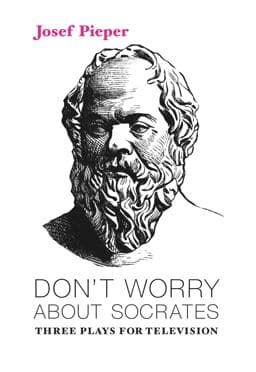
Don't Worry about Socrates
Format: Paperback
ISBN13: 9781587311963
Paperback|9781587311963
✨ Featured Offer
Brand New
$21.85
List Price: $15.00
🚚
See all 2 offers from $21.85 FREE standard delivery by: 01 Apr 2026
Overview
This book exemplifies Pieper's skills as a communicator. Despite his concentration on the depths--which, beneath the stormy surface level of life, he is constantly able to plumb--Pieper is able to stage his profoundest thoughts. Here, in a clear and appealing Pieper re-enacts the central meanings of three of Plato's most famous dialogues, all touching on the central purpose of life: how do we gain by giving, what is love and how do we show it, what is the purpose of our action and where do we find full happiness?
In the first of the three plays, Gorgias: Or the Abuse of Words and Power, he is able to vent his concerns about the dishonest use of language for purely political purposes or for purely personal advancement. Socrates contends that gaining power does not lead to happiness, and that, in the end, suffering wrong is to be preferred over doing wrong. In the second of the plays, The Symposium, Socrates sits back and listens to all the speakers say what they understand by Eros, for love is seen here in many forms from the speakers. Then, when his turn comes, he merely reports the wise words which Diotima spoke to him about the highest form of Eros--which is love of that which is beautiful in itself, that "is" eternal, that neither becomes nor passes away. In the third play, The Death of Socrates (from Plato's dialogue Phaedo) Pieper shows how Socrates' profound values enable him to face death with equanimity. Even his close disciples and friends (Plato is absent) are nonplussed as they witness his total selfless integrity.
Without popularizing, this book succeeds in highlighting some fundamental issues which are not only central to Plato's thought, but are also shown to be acutely relevant to our current society.
In the first of the three plays, Gorgias: Or the Abuse of Words and Power, he is able to vent his concerns about the dishonest use of language for purely political purposes or for purely personal advancement. Socrates contends that gaining power does not lead to happiness, and that, in the end, suffering wrong is to be preferred over doing wrong. In the second of the plays, The Symposium, Socrates sits back and listens to all the speakers say what they understand by Eros, for love is seen here in many forms from the speakers. Then, when his turn comes, he merely reports the wise words which Diotima spoke to him about the highest form of Eros--which is love of that which is beautiful in itself, that "is" eternal, that neither becomes nor passes away. In the third play, The Death of Socrates (from Plato's dialogue Phaedo) Pieper shows how Socrates' profound values enable him to face death with equanimity. Even his close disciples and friends (Plato is absent) are nonplussed as they witness his total selfless integrity.
Without popularizing, this book succeeds in highlighting some fundamental issues which are not only central to Plato's thought, but are also shown to be acutely relevant to our current society.
| ISBN-13 | 9781587311963 |
|---|---|
| ISBN-10 | 1587311968 |
| Weight | 0.55 Pounds |
| Dimensions | 5.50 x 0.60 x 8.50 In |
| List Price | $15.00 |
| Edition | 1st Edition |
| Format | Paperback |
|---|---|
| Language | English |
| Pages | 168 pages |
| Publisher | St. Augustines Press |
| Published On | 2018-06-15 |
View All Offers
Sort by:
Price
Condition
Seller
Seller Comments
Price
✨ Brand New
Seller details
indoo.com
Avenel, NJ, USA
9781587311963.
Free delivery by: 01 Apr 2026
Used, Good
Seller details
Bonita
Santa Clarita, CA, USA
Access codes and supplements are not guaranteed with used items. May be an ex-library book.
Free delivery by: 01 Apr 2026