
✨ Featured Offer
Used, Very Good
$8.69
List Price: $17.95
🚚
See all 5 offers from $7.60 FREE standard delivery by: 03 Apr 2026
Overview
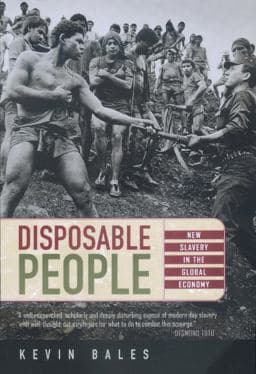
Slavery is illegal throughout the world, yet more than twenty-seven million people are still trapped in one of history's oldest social institutions. Kevin Bales's disturbing story of slavery today reaches from brick kilns in Pakistan and brothels in Thailand to the offices of multinational corporations. His investigation of conditions in Mauritania, Brazil, Thailand, Pakistan, and India reveals the tragic emergence of a "new slavery," one intricately linked to the global economy. The new slaves are not a long-term investment as was true with older forms of slavery, explains Bales. Instead, they are cheap, require little care, and are disposable.
Three interrelated factors have helped create the new slavery. The enormous population explosion over the past three decades has flooded the world's labor markets with millions of impoverished, desperate people. The revolution of economic globalization and modernized agriculture has dispossessed poor farmers, making them and their families ready targets for enslavement. And rapid economic change in developing countries has bred corruption and violence, destroying social rules that might once have protected the most vulnerable individuals.
Bales's vivid case studies present actual slaves, slaveholders, and public officials in well-drawn historical, geographical, and cultural contexts. He observes the complex economic relationships of modern slavery and is aware that liberation is a bitter victory for a child prostitute or a bondaged miner if the result is starvation.
Bales offers suggestions for combating the new slavery and provides examples of very positive results from organizations such as Anti-Slavery International, the Pastoral Land Commission in Brazil, and the Human Rights Commission in Pakistan. He also calls for researchers to follow the flow of raw materials and products from slave to marketplace in order to effectively target campaigns of "naming and shaming" corporations linked to slavery. Disposable People is the first book to point the way to abolishing slavery in today's global economy.
All of the author's royalties from this book go to fund anti-slavery projects around the world.
Three interrelated factors have helped create the new slavery. The enormous population explosion over the past three decades has flooded the world's labor markets with millions of impoverished, desperate people. The revolution of economic globalization and modernized agriculture has dispossessed poor farmers, making them and their families ready targets for enslavement. And rapid economic change in developing countries has bred corruption and violence, destroying social rules that might once have protected the most vulnerable individuals.
Bales's vivid case studies present actual slaves, slaveholders, and public officials in well-drawn historical, geographical, and cultural contexts. He observes the complex economic relationships of modern slavery and is aware that liberation is a bitter victory for a child prostitute or a bondaged miner if the result is starvation.
Bales offers suggestions for combating the new slavery and provides examples of very positive results from organizations such as Anti-Slavery International, the Pastoral Land Commission in Brazil, and the Human Rights Commission in Pakistan. He also calls for researchers to follow the flow of raw materials and products from slave to marketplace in order to effectively target campaigns of "naming and shaming" corporations linked to slavery. Disposable People is the first book to point the way to abolishing slavery in today's global economy.
All of the author's royalties from this book go to fund anti-slavery projects around the world.
| ISBN-13 | 9780520224636 |
|---|---|
| ISBN-10 | 0520224639 |
| Weight | 1.00 Pounds |
| Dimensions | 5.98 x 0.94 x 9.06 In |
| List Price | $17.95 |
| Format | Paperback |
|---|---|
| Language | English |
| Pages | 298 pages |
| Publisher | University of California Press |
| Published On | 2000-08-15 |
View All Offers
Sort by:
Price
Condition
Seller
Seller Comments
Price
Used, Good
Seller details
Midtown Scholar Bookstore
Harrisburg, PA, USA
Good paperback, bumped/creased with shelfwear; may have previous owner's name inside. Standard-sized...
Free delivery by: 03 Apr 2026
✨ Used, Very Good
Seller details
HPB-Ruby
Dallas, TX, USA
Connecting readers with great books since 1972! Used books may not include companion materials, and ...
Free delivery by: 03 Apr 2026
Used, Good
Seller details
BooksRun
Philadelphia, PA, USA
It's a preowned item in good condition and includes all the pages. It may have some general signs ...
Free delivery by: 03 Apr 2026
Used, Very Good
Seller details
isbnbooks
Eugene, OR, USA
University of California, 2000, used trade paperback, light wear, no underlining, cover crease.
Free delivery by: 03 Apr 2026
Used, Very Good
Seller details
The Haunted Bookshop
Iowa City, IA, USA
Free delivery by: 03 Apr 2026