
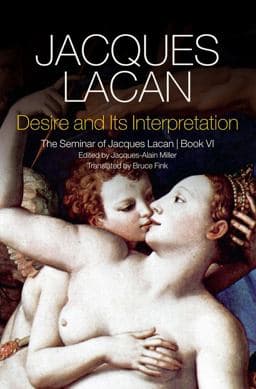
Desire and Its Interpretation
Format: Paperback
ISBN13: 9781509500284
✨ Featured Offer
Brand New
$31.45
List Price: $26.95
FREE standard delivery by: 03 Apr 2026
Overview
What does Lacan show us? He shows us that desire is not a biological function; that it is not correlated with a natural object; and that its object is fantasized. Because of this, desire is extravagant. It cannot be grasped by those who might try to master it. It plays tricks on them. Yet if it is not recognized, it produces symptoms. In psychoanalysis, the goal is to interpret--that is, to read--the message regarding desire that is harbored within the symptom.
Although desire upsets us, it also inspires us to invent artifices that can serve us as a compass. An animal species has a single natural compass. Human beings, on the other hand, have multiple compasses: signifying montages and discourses. They tell you what to do: how to think, how to enjoy, and how to reproduce. Yet each person's fantasy remains irreducible to shared ideals.
Up until recently, all of our compasses, no matter how varied, pointed in the same direction: toward the Father. We considered the patriarch to be an anthropological invariant. His decline accelerated owing to increasing equality, the growth of capitalism, and the ever-greater domination of technology. We have reached the end of the Father Age.
Another discourse is in the process of taking the former's place. It champions innovation over tradition; networks over hierarchies; the draw of the future over the weight of the past; femininity over virility. Where there had previously been a fixed order, transformational flows constantly push back any and all limits.
Freud was a product of the Father Age. He did a great deal to save it. The Catholic Church finally realized this. Lacan followed the way paved by Freud, but it led him to posit that the father is a symptom. He demonstrates that here using Hamlet as an example.
What people have latched onto about Lacan's work--his formalization of the Oedipus complex and his emphasis on the Name-of-the-Father--was merely his point of departure. Seminar VI already revises this: the Oedipus complex is not the only solution to desire, it is merely a normalized form thereof; it is, moreover, a pathogenic form; it does not exhaustively explain desire's course. Hence the eulogy of perversion with which this seminar ends: Lacan views perversion here as a rebellion against the identifications that assure the maintenance of social routines.
This Seminar predicted "the revamping of formally established conformisms and even their explosion." We have reached that point. Lacan is talking about us.
| ISBN-13 | 9781509500284 |
|---|---|
| ISBN-10 | 1509500286 |
| Weight | 1.65 Pounds |
| Dimensions | 5.90 x 1.20 x 9.00 In |
| List Price | $26.95 |
| Edition | 1st Edition |
| Format | Paperback |
|---|---|
| Language | English |
| Pages | 464 pages |
| Publisher | Polity |
| Published On | 2021-03-22 |
View All Offers
Sort by:
Seller details
Columbia, MD, USA
Free delivery by: 03 Apr 2026
Seller details
Avenel, NJ, USA
Free delivery by: 03 Apr 2026
Seller details
Columbia, MD, USA
Free delivery by: 03 Apr 2026
Seller details
Santa Clarita, CA, USA
Free delivery by: 03 Apr 2026
Seller details
Santa Clarita, CA, USA
Free delivery by: 03 Apr 2026