
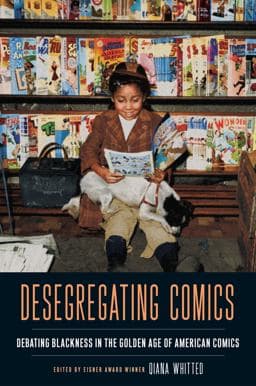
Desegregating Comics
by Qiana Whitted (Editor, Contribution by)Carol L. Tilley (Contribution by)Brian Cremins (Contribution by)Mora Beauchamp-Byrd (Contribution by)Phillip Lamarr Cunningham (Contribution by)Jacque Nodell (Contribution by)Julian C. Chambliss (Contribution by)Mike Lemon (Contribution by)Ian Gordon (Contribution by)Nicholas Sammond (Contribution by)Andrew J. Kunka (Contribution by)Rebecca Wanzo (Contribution by)Chris Gavaler (Contribution by)Monalesia Earle (Contribution by)Blair Davis (Contribution by)Eli Boonin-Vail (Contribution by)
Format:
ISBN13: 9781978825031
|9781978825031
Out of Stock
Overview
Winner of the Comics Studies Society Edited Book Prize
Shortlisted for the Best Academic / Scholarly Work Eisner Award
Honorable Mention for the Harry Shaw and Katrina Hazzard-Donald Award for Outstanding Work in African-American Popular Culture Studies from the Popular Culture Association
Some comics fans view the industry's Golden Age (1930s-1950s) as a challenging time when it comes to representations of race, an era when the few Black characters appeared as brutal savages, devious witch doctors, or unintelligible minstrels. Yet the true portrait is more complex and reveals that even as caricatures predominated, some Golden Age comics creators offered more progressive and nuanced depictions of Black people.
Desegregating Comics assembles a team of leading scholars to explore how debates about the representation of Blackness shaped both the production and reception of Golden Age comics. Some essays showcase rare titles like Negro Romance and consider the formal innovations introduced by Black comics creators like Matt Baker and Alvin Hollingsworth, while others examine the treatment of race in the work of such canonical cartoonists as George Herriman and Will Eisner. The collection also investigates how Black fans read and loved comics, but implored publishers to stop including hurtful stereotypes. As this book shows, Golden Age comics artists, writers, editors, distributors, and readers engaged in heated negotiations over how Blackness should be portrayed, and the outcomes of those debates continue to shape popular culture today.
Shortlisted for the Best Academic / Scholarly Work Eisner Award
Honorable Mention for the Harry Shaw and Katrina Hazzard-Donald Award for Outstanding Work in African-American Popular Culture Studies from the Popular Culture Association
Some comics fans view the industry's Golden Age (1930s-1950s) as a challenging time when it comes to representations of race, an era when the few Black characters appeared as brutal savages, devious witch doctors, or unintelligible minstrels. Yet the true portrait is more complex and reveals that even as caricatures predominated, some Golden Age comics creators offered more progressive and nuanced depictions of Black people.
Desegregating Comics assembles a team of leading scholars to explore how debates about the representation of Blackness shaped both the production and reception of Golden Age comics. Some essays showcase rare titles like Negro Romance and consider the formal innovations introduced by Black comics creators like Matt Baker and Alvin Hollingsworth, while others examine the treatment of race in the work of such canonical cartoonists as George Herriman and Will Eisner. The collection also investigates how Black fans read and loved comics, but implored publishers to stop including hurtful stereotypes. As this book shows, Golden Age comics artists, writers, editors, distributors, and readers engaged in heated negotiations over how Blackness should be portrayed, and the outcomes of those debates continue to shape popular culture today.
| ISBN-13 | 9781978825031 |
|---|---|
| ISBN-10 | 197882503X |
| List Price | $200.00 |
| Format | - |
|---|---|
| Language | English |
| Pages | 326 pages |
| Publisher | |
| Published On | 2023-05-12 |
View All Offers
Sort by:
Price