
✨ Featured Offer
Brand New
$171.24
List Price: $110.00
🚚
See all 3 offers from $40.13 FREE standard delivery by: 05 Apr 2026
Overview
How cognitive psychology explains human creativity
Conventional wisdom holds that creativity is a mysterious quality present in a select few individuals. The rest of us, the common view goes, can only stand in awe of great creative achievements: we could never paint Guernica or devise the structure of the DNA molecule because we lack access to the rarified thoughts and inspirations that bless geniuses like Picasso or Watson and Crick. Presented with this view, today′s cognitive psychologists largely differ finding instead that "ordinary" people employ the same creative thought processes as the greats. Though used and developed differently by different people, creativity can and should be studied as a positive psychological feature shared by all humans.
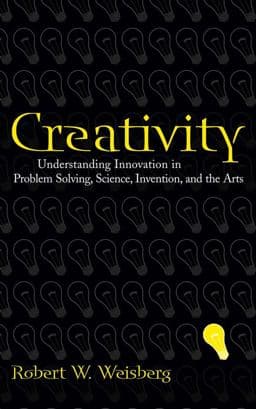
Creativity: Understanding Innovation in Problem Solving, Science, Invention, and the Arts presents the major psychological theories of creativity and illustrates important concepts with vibrant and detailed case studies that exemplify how to study creative acts with scientific rigor.
Creativity includes:
∗ Two in-depth case studies--Watson and Crick′s modeling of the DNA structure and Picasso′s painting of Guernica-- serve as examples throughout the text
∗ Methods used by psychologists to study the multiple facets of creativity
∗ The "ordinary thinking" or cognitive view of creativity and its challengers
∗ How problem-solving and experience relate to creative thinking
∗ Genius and madness and the relationship between creativity and psychopathology
∗ The possible role of the unconscious in creativity
∗ Psychometrics--testing for creativity and how personality factors affect creativity
∗ Confluence theories that use cognitive, personality, environmental, and other components to describe creativity
Clearly and engagingly written by noted creativity expert Robert Weisberg, Creativity: Understanding Innovation in Problem Solving, Science, Invention, and the Arts takes both students and lay readers on an in-depth journey through contemporary cognitive psychology, showing how the discipline understands one of the most fundamental and fascinating human abilities.
"This book will be a hit. It fills a large gap in the literature. It is a well-written, scholarly, balanced, and engaging book that will be enjoyed by students and faculty alike."
--David Goldstein, University of Toronto
Conventional wisdom holds that creativity is a mysterious quality present in a select few individuals. The rest of us, the common view goes, can only stand in awe of great creative achievements: we could never paint Guernica or devise the structure of the DNA molecule because we lack access to the rarified thoughts and inspirations that bless geniuses like Picasso or Watson and Crick. Presented with this view, today′s cognitive psychologists largely differ finding instead that "ordinary" people employ the same creative thought processes as the greats. Though used and developed differently by different people, creativity can and should be studied as a positive psychological feature shared by all humans.
Creativity: Understanding Innovation in Problem Solving, Science, Invention, and the Arts presents the major psychological theories of creativity and illustrates important concepts with vibrant and detailed case studies that exemplify how to study creative acts with scientific rigor.
Creativity includes:
∗ Two in-depth case studies--Watson and Crick′s modeling of the DNA structure and Picasso′s painting of Guernica-- serve as examples throughout the text
∗ Methods used by psychologists to study the multiple facets of creativity
∗ The "ordinary thinking" or cognitive view of creativity and its challengers
∗ How problem-solving and experience relate to creative thinking
∗ Genius and madness and the relationship between creativity and psychopathology
∗ The possible role of the unconscious in creativity
∗ Psychometrics--testing for creativity and how personality factors affect creativity
∗ Confluence theories that use cognitive, personality, environmental, and other components to describe creativity
Clearly and engagingly written by noted creativity expert Robert Weisberg, Creativity: Understanding Innovation in Problem Solving, Science, Invention, and the Arts takes both students and lay readers on an in-depth journey through contemporary cognitive psychology, showing how the discipline understands one of the most fundamental and fascinating human abilities.
"This book will be a hit. It fills a large gap in the literature. It is a well-written, scholarly, balanced, and engaging book that will be enjoyed by students and faculty alike."
--David Goldstein, University of Toronto
| ISBN-13 | 9780471739999 |
|---|---|
| ISBN-10 | 0471739995 |
| Weight | 2.46 Pounds |
| Dimensions | 6.50 x 1.60 x 9.50 In |
| List Price | $110.00 |
| Edition | 1st Edition |
| Format | Hardcover |
|---|---|
| Language | English |
| Pages | 640 pages |
| Publisher | Wiley |
| Published On | 2006-04-28 |
View All Offers
Sort by:
Price
Condition
Seller
Seller Comments
Price
Used, Good
Seller details
Bonita
Santa Clarita, CA, USA
Access codes and supplements are not guaranteed with used items. May be an ex-library book.
Free delivery by: 05 Apr 2026
✨ Brand New
Seller details
Bonita
Santa Clarita, CA, USA
Free delivery by: 05 Apr 2026
Brand New
Seller details
GridFreed
San Diego, CA, USA
Size: 104x25x151; In shrink wrap. Looks like an interesting title!
Free delivery by: 05 Apr 2026