
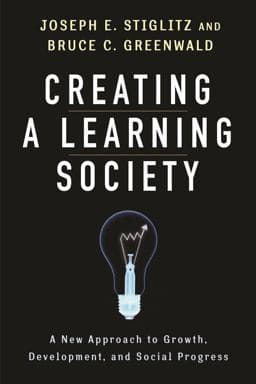
Creating a Learning Society
by Kenneth Arrow (As told to)Robert Solow (As told to)Michael Woodford (As told to)Joseph E. StiglitzBruce GreenwaldPhilippe Aghion (As told to)
Format: Hardcover
ISBN13: 9780231152143
Hardcover|9780231152143
✨ Featured Offer
Overview
It has long been recognized that an improved standard of living results from advances in technology, not from the accumulation of capital. It has also become clear that what truly separates developed from less-developed countries is not just a gap in resources or output but a gap in knowledge. In fact, the pace at which developing countries grow is largely a function of the pace at which they close that gap.
Thus, to understand how countries grow and develop, it is essential to know how they learn and become more productive and what government can do to promote learning. In Creating a Learning Society, Joseph E. Stiglitz and Bruce C. Greenwald cast light on the significance of this insight for economic theory and policy. Taking as a starting point Kenneth J. Arrow's 1962 paper "Learning by Doing," they explain why the production of knowledge differs from that of other goods and why market economies alone typically do not produce and transmit knowledge efficiently. Closing knowledge gaps and helping laggards learn are central to growth and development. But creating a learning society is equally crucial if we are to sustain improved living standards in advanced countries.
Combining accessible prose with technical economic analysis, Stiglitz and Greenwald provide new models of "endogenous growth," up-ending thowhe thinking about both domestic and global policy and trade regimes. They show well-designed government trade and industrial policies can help create a learning society, and how poorly designed intellectual property regimes can retard learning. They also explain how virtually every government policy has effects, both positive and negative, on learning, a fact that policymakers must recognize. They demonstrate why many standard policy prescriptions, especially those associated with "neoliberal" doctrines focusing on static resource allocations, have impeded learning. Among the provocative implications are that free trade may lead to stagnation whereas broad-based industrial protection and exchange rate interventions may bring benefits--not just to the industrial sector, but to the entire economy.
The volume concludes with brief commentaries from Philippe Aghion and Michael Woodford, as well as from Nobel Laureates Kenneth J. Arrow and Robert M. Solow.
Thus, to understand how countries grow and develop, it is essential to know how they learn and become more productive and what government can do to promote learning. In Creating a Learning Society, Joseph E. Stiglitz and Bruce C. Greenwald cast light on the significance of this insight for economic theory and policy. Taking as a starting point Kenneth J. Arrow's 1962 paper "Learning by Doing," they explain why the production of knowledge differs from that of other goods and why market economies alone typically do not produce and transmit knowledge efficiently. Closing knowledge gaps and helping laggards learn are central to growth and development. But creating a learning society is equally crucial if we are to sustain improved living standards in advanced countries.
Combining accessible prose with technical economic analysis, Stiglitz and Greenwald provide new models of "endogenous growth," up-ending thowhe thinking about both domestic and global policy and trade regimes. They show well-designed government trade and industrial policies can help create a learning society, and how poorly designed intellectual property regimes can retard learning. They also explain how virtually every government policy has effects, both positive and negative, on learning, a fact that policymakers must recognize. They demonstrate why many standard policy prescriptions, especially those associated with "neoliberal" doctrines focusing on static resource allocations, have impeded learning. Among the provocative implications are that free trade may lead to stagnation whereas broad-based industrial protection and exchange rate interventions may bring benefits--not just to the industrial sector, but to the entire economy.
The volume concludes with brief commentaries from Philippe Aghion and Michael Woodford, as well as from Nobel Laureates Kenneth J. Arrow and Robert M. Solow.
| ISBN-13 | 9780231152143 |
|---|---|
| ISBN-10 | 0231152140 |
| Weight | 2.30 Pounds |
| Dimensions | 6.50 x 2.00 x 9.50 In |
| List Price | $34.95 |
| Edition | 1st Edition |
| Format | Hardcover |
|---|---|
| Language | English |
| Pages | 680 pages |
| Publisher | Columbia University Press |
| Published On | 2014-06-24 |
View All Offers
Sort by:
Price
Condition
Seller
Seller Comments
Price
Used, Very Good
Seller details
Midtown Scholar Bookstore
Harrisburg, PA, USA
Very Good-Crisp, clean, unread book with some shelfwear/edgewear, may have a remainder mark-NICE Sta...
Free delivery by: 03 Apr 2026
Used, Good
Seller details
Midtown Scholar Bookstore
Harrisburg, PA, USA
Good-Bumped and creased book with tears to the extremities, but not affecting the text block, may ha...
Free delivery by: 03 Apr 2026
Used, Good
Seller details
Wonder Book - Member ABAA/ILAB
Frederick, MD, USA
Good condition. Very Good dust jacket. A copy that has been read but remains intact. May contain m...
Free delivery by: 03 Apr 2026
✨ Brand New
Seller details
EKER Books
Bryantown, MD, USA
Free delivery by: 03 Apr 2026
Used, Very Good
Seller details
Half Price Books Inc
Dallas, TX, USA
Connecting readers with great books since 1972! Used books may not include companion materials, and ...
Free delivery by: 03 Apr 2026