
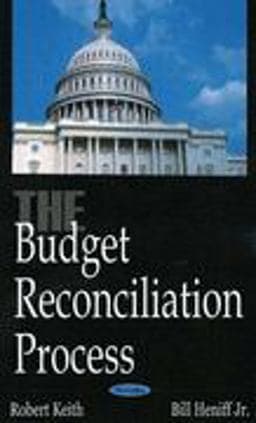
Budget Reconciliation Process
Format: Paperback
ISBN13: 9781594547805
Paperback|9781594547805
✨ Featured Offer
Brand New
$68.68
List Price: $62.00
🚚
See all 1 offers from $68.68 FREE standard delivery by: 31 Mar 2026
Overview
The budget reconciliation process is an optional procedure that operates as an adjunct to the budget resolution process established by the Congressional Budget Act of 1974. The chief purpose of the reconciliation process is to enhance Congress's ability to change current law in order to bring revenue, spending, and debt-limit levels into conformity with the policies of the annual budget resolution. Reconciliation is a two-stage process. First, reconciliation directives are included in the budget resolution, instructing the appropriate committees to develop legislation achieving the desired budgetary outcomes. If the budget resolution instructs more than one committee in a chamber, then the instructed committees submit their legislative recommendations to their respective Budget Committees by the deadline prescribed in the budget resolution; the Budget Committees incorporate them into an omnibus budget reconciliation bill without making any substantive revisions. In cases where only one committee has been instructed, the process allows that committee to report its reconciliation legislation directly to its parent chamber, thus bypassing the Budget Committee. The second step involves consideration of the resultant reconciliation legislation by the House and Senate under expedited procedures. Among other things, debate in the Senate on any reconciliation measure is limited to 20 hours (and 10 hours on a conference report) and amendments must be germane and not include extraneous matter. The House Rules Committee typically recommends a special rule for the consideration of a reconciliation measure in the House that places restrictions on debate time and the offering of amendments. As an optional procedure, reconciliation has not been used in every year that the congressional budget process has been in effect. Beginning with the first use of reconciliation by both the House and Senate in 1980, however, reconciliation has been used in most years. In three years, 1998 (for FY1999), 2002 (for FY2003), and 2004 (for FY2005), the House and Senate did not agree on a budget resolution. Congress has sent the President 19 reconciliation acts over the years; 16 were signed into law and three were vetoed (and the vetoes not overridden). Following an introduction that provides an overview of the reconciliation process and discusses its historical development, the book explains the process in sections dealing with the underlying authorities, reconciliation directives in budget resolutions, initial consideration of reconciliation measures in the House and Senate, resolving House-Senate differences on reconciliation measures, and presidential approval or disapproval of such measures. The text of two relevant sections of the Congressional Budget Act of 1974 (Sections 310 and 313) is set forth in the Appendices.
| ISBN-13 | 9781594547805 |
|---|---|
| ISBN-10 | 1594547807 |
| Weight | 0.44 Pounds |
| Dimensions | 5.25 x 0.25 x 8.25 In |
| List Price | $62.00 |
| Format | Paperback |
|---|---|
| Language | English |
| Pages | 118 pages |
| Publisher | Nova Novinka |
| Published On | 2006-01-01 |
View All Offers
Sort by:
Price
Condition
Seller
Seller Comments
Price
✨ Brand New
Seller details
Paperbackshop
Bensenville, IL, USA
New Book. Shipped from UK in 4 to 14 days. Established seller since 2000. Please note we cannot of...
Free delivery by: 31 Mar 2026