
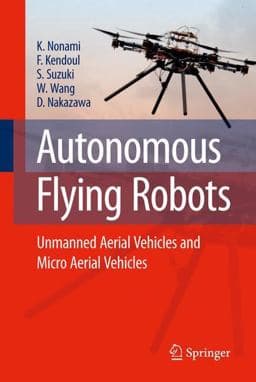
Autonomous Flying Robots
Format:
ISBN13: 9784431538561
|9784431538561
Out of Stock
Overview
The advance in robotics has boosted the application of autonomous vehicles to perform tedious and risky tasks or to be cost-effective substitutes for their - man counterparts. Based on their working environment, a rough classi cation of the autonomous vehicles would include unmanned aerial vehicles (UAVs), - manned ground vehicles (UGVs), autonomous underwater vehicles (AUVs), and autonomous surface vehicles (ASVs). UAVs, UGVs, AUVs, and ASVs are called UVs (unmanned vehicles) nowadays. In recent decades, the development of - manned autonomous vehicles have been of great interest, and different kinds of autonomous vehicles have been studied and developed all over the world. In part- ular, UAVs have many applications in emergency situations; humans often cannot come close to a dangerous natural disaster such as an earthquake, a ood, an active volcano, or a nuclear disaster. Since the development of the rst UAVs, research efforts have been focused on military applications. Recently, however, demand has arisen for UAVs such as aero-robotsand ying robotsthat can be used in emergency situations and in industrial applications. Among the wide variety of UAVs that have been developed, small-scale HUAVs (helicopter-based UAVs) have the ability to take off and land vertically as well as the ability to cruise in ight, but their most importantcapability is hovering. Hoveringat a point enables us to make more eff- tive observations of a target. Furthermore, small-scale HUAVs offer the advantages of low cost and easy operation.
| ISBN-13 | 9784431538561 |
|---|---|
| ISBN-10 | 4431538569 |
| List Price | $219.00 |
| Format | - |
|---|---|
| Language | English |
| Pages | 329 pages |
| Publisher | Springer |
| Published On | 2010-09-15 |
View All Offers
Sort by:
Price