
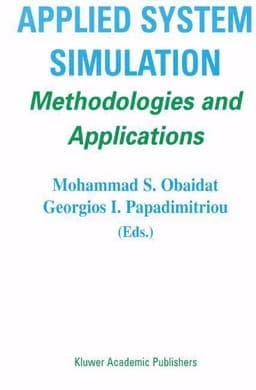
Applied System Simulation
Format: Paperback
ISBN13: 9781461348436
Paperback|9781461348436
✨ Featured Offer
Brand New
$172.16
List Price: $169.99
🚚
See all 1 offers from $172.16 FREE standard delivery by: 30 Mar 2026
Overview
Simulation and molding are efficient techniques that can aid the city and regional planners and engineers in optimizing the operation of urban systems such as traffic light control, highway toll automation, consensus building, public safety, and environmental protection. When modeling transportation systems such as freeway systems, arterial or downtown grid systems, the city planner and engineer is concerned with capturing the varied interactions between drivers, automobiles, and the infrastructure. Modeling and simulation are used to effectively optimize the design and operation of all of these urban systems. It is possible that in an urban simulation community workshop, citizens can work interactively in front of computers and be able using the click of the mouse to walk up to their own front porch, looking at the proposed shopping mall alternatives across the street from virtually any angle and proposed bridge or tunnel and see how it can reduce traffic congestion. Buildings can be scaled down or taken out, their orientation can be changed in order to check the view and orientation in order to have better site with efficient energy-conservation. The stone or brick material on a building can be replaced by colored concrete, or more trees and lampposts can be placed on the site. Such flexibility in simulation and animation allows creative ideas in the design and orientation of urban sites to be demonstrated to citizens and decision makers before final realization.
| ISBN-13 | 9781461348436 |
|---|---|
| ISBN-10 | 1461348439 |
| Weight | 1.75 Pounds |
| Dimensions | 6.10 x 1.19 x 9.25 In |
| List Price | $169.99 |
| Edition | 1st Edition |
| Format | Paperback |
|---|---|
| Language | English |
| Pages | vi, 515 pages |
| Publisher | Springer |
| Published On | 2013-02-13 |
View All Offers
Sort by:
Price
Condition
Seller
Seller Comments
Price
✨ Brand New
Seller details
Alibris
Sparks, NV, USA
Print on demand Trade paperback (US). Glued binding. 515 p.
Free delivery by: 30 Mar 2026